
At 6:45 p.m., just as you are about to shut your laptop, a ‘quick request’ drops into your inbox from work. It is marked urgent. You pause. Do you respond now and prove you are committed, or wait until morning and risk being seen as unavailable?
This is the quiet tension behind setting boundaries at work. Many professionals worry that drawing limits might make them appear difficult, less ambitious, or not team-oriented. Yet organisational research consistently links blurred work-life boundaries to higher stress levels, reduced focus, and increased burnout at work.
The real question is not whether boundaries are polite or rude. It is whether they are professional and whether they strengthen or weaken your long-term performance.
What Setting Boundaries at Work Actually Means
Setting boundaries at work does not mean building walls. It means defining parameters. Workplace boundaries clarify what you will prioritise, when you are available, and what responsibilities sit within your role. They provide structure in environments where expectations can easily expand.
Time boundaries determine when you start and stop working, and how you manage after-hours communication. Mental boundaries protect your attention, reducing the tendency to carry unfinished tasks into your evenings. Emotional boundaries prevent you from absorbing every frustration around you. Role boundaries define the limits of your responsibilities, helping you avoid silent job expansion without recognition.
Employees who maintain a clearer work-life balance report lower stress and a greater ability to detach from work outside office hours. Detachment is not disengagement; it is recovery. Recovery improves concentration, decision-making, and resilience. Boundaries, therefore, function as performance tools rather than personal preferences.
Read: Tips for Self-Introductions During an Interview
Why Professionals Struggle to Say No at Work
If boundaries are beneficial, why do they feel risky? The answer often lies in workplace culture. Many industries reward visible busyness and constant availability. Early-career professionals may feel pressure to prove themselves by saying yes to everything. In hierarchical settings, power imbalances make it difficult to push back against senior colleagues.
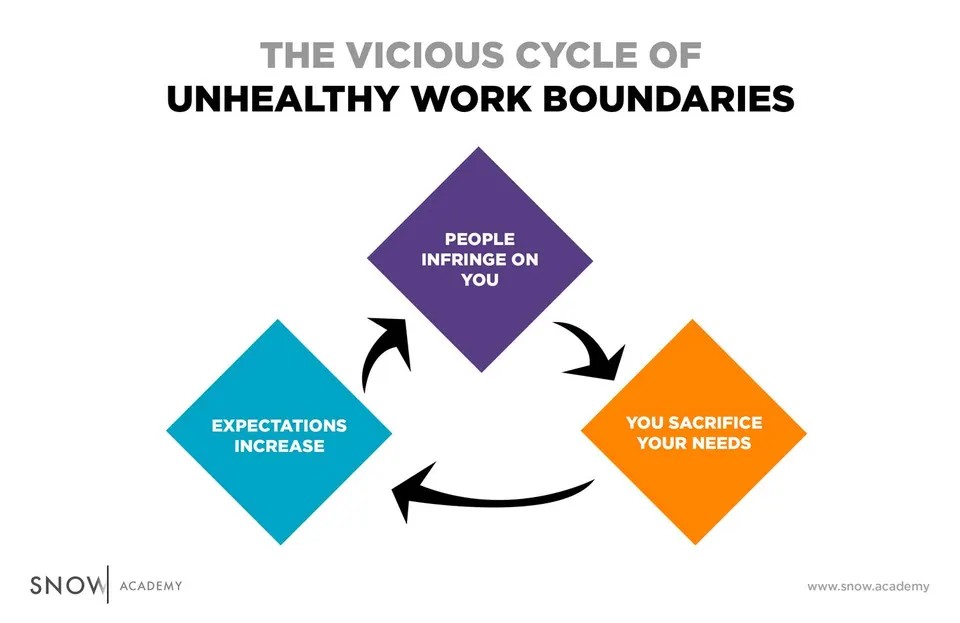
There is also an internal driver. Some professionals tie identity closely to output. The more they work, the more valuable they feel. Yet research on workaholism suggests that excessive hours do not automatically translate into higher performance. Instead, they strongly correlate with stress, work-life conflict, and burnout at work.
The issue is not commitment. It is sustainability. A career is rarely defined by one late evening response. It is shaped by consistent, high-quality contributions over time. Without boundaries, that consistency becomes harder to maintain.
How Boundaries Improve Performance
Clear workplace boundaries enhance focus. Research on interruptions shows that employees switch tasks frequently, often every 10 to 15 minutes. After an interruption, it can take up to 25 minutes to regain full concentration. Across teams, this pattern creates measurable productivity loss. When professionals define availability windows or protect deep work time, they reduce cognitive fragmentation.
Boundaries also improve clarity. When you specify delivery timelines instead of responding instantly to every request, you manage expectations. Colleagues learn how and when to engage you effectively. This reduces confusion and reactive workflows.
Leaders who set boundaries model discipline. They demonstrate that productivity is about outcomes, not performative availability. Teams benefit from clearer delegation, structured communication, and reduced emotional spillover. Far from limiting ambition, boundaries reinforce professional credibility. They signal that you understand your capacity and respect your responsibilities.
Boundaries, applied well, are operational tools. They organise time, energy, and attention in ways that support both individual and organisational performance.
Read: Love Languages in Workplaces
How to Set Boundaries Without Damaging Your Career
Effective boundary setting requires preparation, not emotion. First, clarify your priorities. Identify what is non-negotiable and what is flexible. Align these decisions with organisational goals. When your limits support business outcomes, they carry more weight.
Second, communicate precisely. Replace emotional language with structured responses. Instead of saying, ‘I am overwhelmed,’ say, ‘I can deliver this by 10:00 a.m. tomorrow.’ Clear timelines reduce ambiguity and maintain professionalism.
Third, offer alternatives rather than refusals. If you cannot attend a late meeting, propose another slot. If a task falls outside your role, suggest the appropriate contact or clarify the scope before proceeding. This demonstrates collaboration without absorbing unlimited responsibility.
Finally, document agreements. Confirm deliverables and deadlines in writing to prevent role creep. Written clarity protects both you and your team from misaligned expectations.Boundaries work best when they are consistent. Occasional limits followed by habitual overextension send mixed signals. Consistency builds respect.
So, Yes or No?
The answer is yes, strategically. Setting boundaries at work does not reduce effort; it channels it. It protects energy for meaningful contribution and sustains performance across months and years. In an era of hybrid schedules, digital notifications, and expanding responsibilities, professionals who define their limits thoughtfully will operate with greater clarity and endurance.
Boundaries are not about doing less. They are about working with intention.For more practical insights on professional growth, leadership, and performance, follow RefinedNG and explore more learning and development stories on our platform.