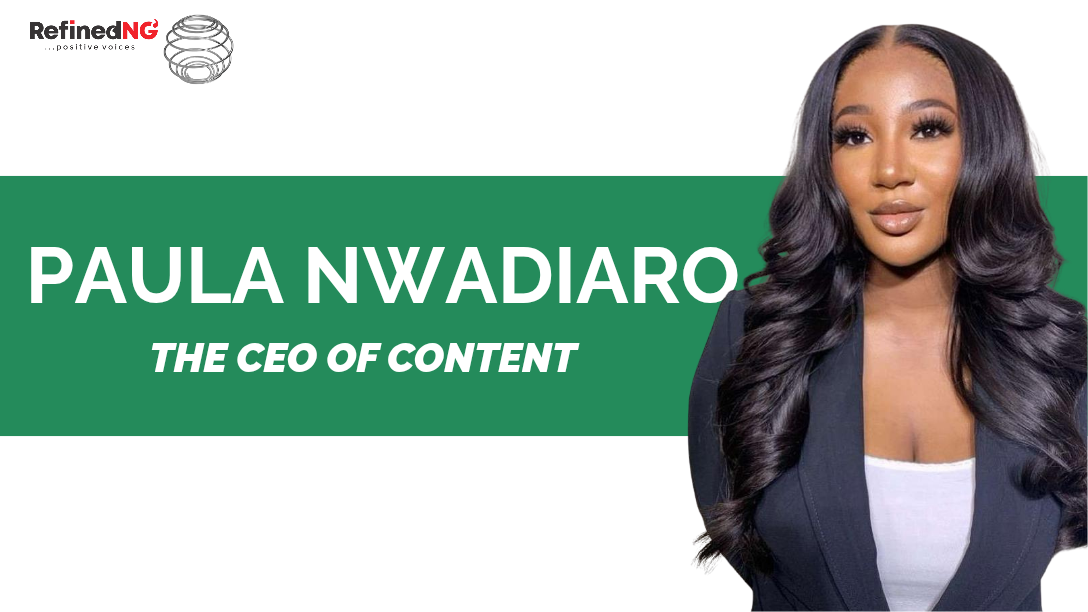
When we first spoke with Techwriteable’s founder, Peter Ogundairo, one name slipped into the conversation — Paula Nwadiaro. Not as a client, but as a voice; someone using thought leadership not for clout, but for clarity. She had launched a bold content-analysis series on Techwriteable that dissected how Nigerian startups like PiggyVest, Kuda, and others build connections through storytelling.
That mention sparked our curiosity. Who is the woman who writes brand analyses like essays and weaves data into emotion? We quickly learned Paula isn’t your typical marketer. She studied Microbiology, dabbled in design, writes with strategic precision, and mentors other writers to find their voice in the chaos of algorithms.
In this conversation, Paula takes us behind her shift from lab work to laptops, the thinking behind her Techwriteable series, and why she believes good content is less about “selling” and more about seeing.
Paula, before we get into strategy and storytelling — who were you before the “CEO of Content” title? If someone met you before all this, how would you describe the girl who studied Microbiology? What was she dreaming about, and how close is that dream to what you do now?
Paula: Before the “CEO of Content” title, I was a really shy, introverted girl who spent more time reading my novels. I loved to cook, and if you caught me on a good day, I’d probably be dancing kompa while cooking in the kitchen. Most of my university days were a mix of classes and running a small food business with my friends. I wanted to be a medical doctor back then, neuroscience and genetic engineering fascinated me. (And no, Ben Carson had nothing to do with it lol.)
But somewhere between life and school, I realized I loved observing people, what made them curious, what made them act, etc. It’s funny now, but the same curiosity that drove me to study the human brain is what drives me to understand audiences today. I might still go back to study medicine someday, who knows? But right now, I’m enjoying all things content, creativity, and strategy. And I think I’m right where I’m meant to be.
Read: Aroloye Oluwatosin Wants Teachers to Be Seen, Heard, and Valued
From petri dishes to pixels — that’s not a linear path. Was your transition from science to storytelling accidental or intentional? And do you ever find that your background in Microbiology shapes how you approach content — like how you experiment, measure results, or study audience behavior?
Paula: Honestly, I’m still shocked that the internet knows I studied Microbiology (lmaooo). I nearly screamed when I saw it online. But yes, the switch was completely accidental. I’ve always loved reading and writing. I started writing fiction in JSS2, mostly short stories and random scenes I made up after class.
One day, my friends joked that since I couldn’t get paid to read all my novels, I might as well get paid to write. I had the literary background anyway, thanks to all those compositions I wrote and transcribed by sound (Miss Josephine, if you’re reading this, I forgive you). So, I said bet.
Writing turned out to be way less stressful than running my cooking business, so I leaned into it. And yes, I think my science background shows up more than I realize. I study people the same way I’d study, yunno, observe patterns, test hypotheses, and tweak until something works. Content might not live in a petri dish, but the curiosity and experimentation mindset? That never left. I can’t believe I’m making MCB jokes.
Let’s rewind to the Techwriteable series — the one that first caught our attention. What triggered it? Was it a burst of curiosity, or a quiet frustration with how brand storytelling was being done?
Take us into your thought process the day you decided, “Okay, I’m going to start writing these reviews publicly.”
Paula: I had read an article one day and realized that if I really wanted to get to my dream of 100 brands, I had to study their strategies and show them how valuable I could be. That was the trigger. So I decided to start writing case studies on those brands and putting them out publicly to get visibility.
Techwriteable made that super easy, I love how my case studies look on that platform lol. It was supposed to just be me documenting what I was learning, but it turned into this cool thing where people started paying attention, and brands I admired actually noticed.
You wrote a sharp review of PiggyVest’s content strategy that Peter Ogundairo said he shared with their team. When you were writing that, were you thinking about visibility, value, or just your own creative itch? And what did that experience teach you about how brands communicate trust?
Paula: I think I was just on my own that day when a PiggyVest mobile pop-up showed up on my phone. Then I got on X and saw someone ask, “How did PiggyVest even get so popular?” She said she couldn’t decide between using Cowrywise or PiggyVest, and the replies were full of people swearing by PiggyVest.
That got me curious, too. How did they become so trustworthy? What were they doing differently? And why is their handler so effortlessly funny?
That curiosity pushed me to add them to my Techwriteable series and start strong with them. I wasn’t even thinking about visibility at the time, I just wanted to understand what made people believe in a brand so deeply. But it ended up being one of those pieces that proved how far good storytelling and trust can take you.
Publishing your thoughts so boldly isn’t easy — especially when you’re analyzing others’ work. Were you ever nervous about how brands might respond? Or do you see visibility as part of growth — a kind of necessary exposure for anyone serious about thought leadership?
Paula: Yes and no. I wouldn’t say I was strictly analyzing brands. I was learning from them and wanted people to learn from me learning from them. That was the goal. If visibility came from that, I wasn’t going to complain.
And yes, visibility is a big part of growth. Networking is great, but imagine being seen, loved, and commended for your work, that’s a different kind of validation. I think it’s necessary. It builds trust even with people who’ve never met you before. They start to associate your name with value, and that’s how thought leadership really grows.
You blend writing, design, and marketing — three crafts most people keep separate. When you start a new project, what’s your process? Do you begin with the emotion you want to evoke, the story you want to tell, or the metrics you want to move?
Paula: For me, it always starts with how it looks. My mum always says, “The eyes eat first,” when cooking. Imagine what you’re cooking tastes and smells good but looks horrendous? So when I look at anything, I pay attention to the visuals first: does it attract me? Then I move to the text, is it easy to understand, who’s it for, and is it actually hitting the point?
Marketing, to me, is about building trust. It’s showing people you’re reliable, that you understand their needs, wants, and problems and you can help. So blending writing, design, and marketing comes naturally. They all feed into each other. The design draws you in, the writing keeps you there, and the marketing makes you believe, makes you want to try.
You call yourself the “CEO of Content.” It’s confident, a little rebellious, and oddly relatable. Was that title a branding move, a joke that stuck, or your way of redefining what leadership looks like in creative work?
Paula: You can definitely say it was a branding move. It’s how I want people to see me and honestly, how I see myself for the near future. “CEO of Content” just felt right. It’s confident, it’s a little unserious, but it sticks.
So yeah, “Award of the yen yen yen goes to Paula, the CEO of Content.” I can see that too.
One thing that stands out in your writing — even your B2B and B2C strategy pieces — is how human it feels. How do you manage to write about complex brand strategy without losing empathy and storytelling rhythm? And what’s your honest take on the tension between writing for people and writing for performance metrics?
Paula: I look at a lot of strategy pieces, and honestly, some of them are hard for me to read. So I run away from them. Because of that, I try to dumb it down to a place where I can understand it first, that’s how I learn. I assume there are some people out there like me, so I translate that same clarity for them.
I like to make things humorous, funny, you know, so I use simple examples and make sure you actually enjoy reading. You’ve never heard me speak but somehow I’m sure you can hear me in your head. Whether I’m talking about machine learning, childbirth, or Staphylococcus aureus, I want you to laugh a little and walk away understanding it, even with zero knowledge.
People connect to stories. So when something feels too difficult, I find a story that carries it. That’s my trick. I think that’s why case studies are so cool as well. Somehow, I can always tie even the hardest topics to a story. That’s how I keep it human. And thank you for noticing that, it means a lot.
Read: Lagos Hustle Diaries: Ameenah’s Eight Alarms
You’ve worked on both B2B and B2C projects, which demand different storytelling muscles. What fascinates you most about bridging those two worlds? And what do you think most writers still misunderstand about how to connect with each type of audience?
Paula: I honestly think B2B and B2C are very similar. B2B is just B2C on a more professional scale. The main difference is how you speak to them, your tone, your medium, and your choice of words.
“Buy one, get one free” in B2C becomes “stand a chance to get a free brand consultation after your purchase” in B2B. See? Same goal, different language.
At the end of the day, they’re both people. They’re human before they’re B2C or B2B. Writers forget that sometimes. You should always appeal to their emotions, what do you want them to feel when they read your content? That’s my trick.
You mentor and coach writers who are just figuring things out — pricing, confidence, niche. What’s the biggest mindset hurdle you see, especially among African freelancers? And what practical shift can help them move from survival mode to strategy mode?
Paula: The biggest hurdle I see is the comparison and the pressure. Everyone’s in survival mode — trying their best, doing the work over and over, and still feeling like they’re not enough because they’re not getting the same results others are.
I always tell writers to just breathe. Get a support system, my girls and I (my boys too) vent to each other, tell ourselves, “omo we go dey alright” and lock in again. Ignore the outside noise. Ask for help. Put yourself out there and be you, you’re your biggest brand.
Stop comparing or pushing yourself to the point of burnout. Get a mentor, someone who can guide you and remind you of what’s possible. Then breathe again, and build your portfolio. That’s how you move from survival to strategy, slowly, steadily, and within a community.
Peter Ogundairo once said, “Authorship credit is the new CV.” How has that played out in your own journey? What role has your portfolio — or even your public writing — played in shaping the kind of clients and communities you attract?
Paula: My portfolio has a lot going on, “Head of Marketing, Marketing Assistant, Content and Communications Lead” so sometimes I’m convinced people see my CV and think, “Yeah, she’s overqualified,” which might explain the silence after some applications lmaooo.
But honestly, my public writing has changed my life the most. Being seen and trusted by people from all over, Australia, Canada, and the UK, it’s humbling. So yeah, building in public has had the biggest impact.
I always say, “Build in public,” and I’m still telling myself that too. I went from being shy about it to fully embracing it. That’s probably the only kind of “public” you’ll ever see me in, because I still don’t like leaving my house.
Let’s talk about visibility. In an online world where everyone’s performing success, how do you stay grounded in authenticity? Do you ever feel pressured to always show up, even when you’d rather create quiet?
Paula: I do, (omg), I’m actually struggling with that right now. Trying to find my voice again. As soon as I do, I’m coming back to build chronically.
It’s so easy to get lost in the noise online. Everyone’s performing, everyone’s trying to be seen. You have to be really intentional about staying grounded. For me, that means taking social media breaks, creating quietly when I need to, and reminding myself that I’m me and don’t need to be anyone else or adopt their tone.
If you stripped away all titles — strategist, writer, coach — what do you want your work to say about you? When someone reads a Paula Nwadiaro piece, what do you hope they feel or take away?
Paula: If you stripped away all the titles, I just want my work to make people feel one thing, “Oh wow, I can do it too.”
That’s it. I want someone to read something I wrote, see themselves in it, and feel capable. Whether it’s a brand trying to tell its story better or a writer just starting out, if my work makes you believe you can try, then I’ve done my part.
Finally, if you could speak to the Paula who was still in the lab coat, unsure where this curiosity would lead — what would you tell her? And what’s next for you? What’s the story you’re hungry to tell now?
Paula: I’d tell her to start earlier ooo. Don’t be scared. We’re retiring at 30, abeg ooo. Lock in, Jesus Christ, have you seen the economy? Turkey is no longer 600 ooo!
As for what’s next… let’s just say I’ve got some exciting plans cooking. If I’m able to pull them off by 2026, it’ll be the biggest heist of my career, in the best way possible. I DO NOT MEAN STEALING (lmaoo). I can’t say much yet (I signed an NDA), but stay tuned. It’s going to be good.