

On the 1st of February 2026, as the world celebrated the start of Black History Month, Kwamé Ryan stepped onto the Grammy stage and made history. The Charlotte Symphony Orchestra’s music director became the first Black conductor to win a Grammy for Best Opera Recording for Jake Heggie’s Intelligence.
The applause that night was more than recognition of a brilliant performance; it was a moment that rewrote the story of representation in classical music. For Ryan, it was the culmination of decades spent perfecting his craft, travelling across continents, and proving that talent knows no colour or borders.
Read: 5 Things to Know About My Father’s Shadow After Its BAFTA Win
Toronto Summers and a Conductor’s Dream
Ryan’s journey began in Toronto, where a childhood summer would plant the seed for a remarkable career. In 1977, his parents took him and his sister to Ontario Place to watch Porgy and Bess.

As the orchestra played, Ryan found himself mesmerised by the figure in the centre, the conductor. He turned to his mother and said, Mom, I want to do what that guy is doing. At the time, he didn’t even know the role had a name. That spark, a simple childhood fascination, would guide him through years of study and travel.
A few decades later, he would win a Grammy with the same opera company whose performance first inspired him, the Houston Grand Opera. It was a full-circle moment that reminded him of the power of following one’s curiosity.
From Bordeaux to the Big Stage
Ryan’s career has been as international as it is impressive. After studying musicology at Cambridge and honing his conducting under mentors like Peter Eötvös and Lothar Zagrosek, he held leadership roles across Europe.
He served as General Music Director at the Freiburg Opera and Philharmonic, then as music director at the Orchestre National Bordeaux Aquitaine. Guest conducting assignments took him to Germany, France, the United States, the United Kingdom, and South Korea.
Along the way, he collaborated with orchestras like the New York Philharmonic, English National Opera, and the Seoul Philharmonic. Every stop built his reputation for precision, sensitivity, and the ability to bring music to life.
By the time he joined the Charlotte Symphony Orchestra, Ryan had already become a global ambassador for classical music, blending technical mastery with a vision that embraced creativity, diversity, and cultural dialogue.
More Than Notes: Changing the Classical Landscape
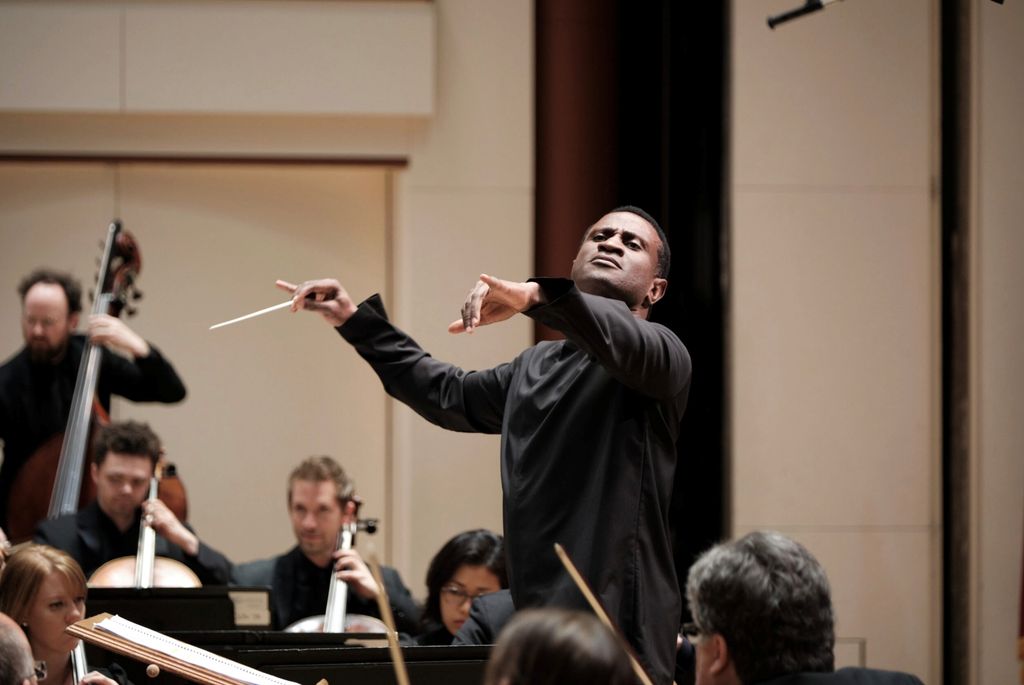
Ryan’s Grammy win is more than a personal milestone.
It’s a moment that amplifies representation in a field where Black musicians are rarely seen at the forefront. Speaking about the importance of visibility, he noted that while sports stars are everywhere on TV, Black classical musicians often remain hidden. ‘If you want to see a great Black classical artist, you have to really go and find them,’ he said.
Through his work, Ryan hopes to inspire children of colour to see themselves in classical music, reminding them that the podium belongs to anyone with talent and determination. The award also elevates the Charlotte Symphony Orchestra, placing it on the global stage and showing that excellence and innovation are not bound by geography.
Read: 5 Things We Know About Akinola Davies Jr.
Celebrating Excellence, Conducting the Future
As Ryan continues his tenure with the Charlotte Symphony, he looks forward to championing new voices and pushing the boundaries of classical performance.
Upcoming programmes include collaborations with composers like Levi Taylor and performances designed to highlight resilience and creativity. His vision goes beyond individual accolades; it’s about building an environment where young musicians of all backgrounds can thrive.
For the city of Charlotte and classical music enthusiasts worldwide, Ryan’s achievement is a reminder that dedication, curiosity, and talent can open doors and inspire generations. His baton now carries not only music but the promise of inclusivity, excellence, and lasting impact.
Celebrate Black excellence in the arts by following RefinedNG. Share this story and join the conversation about representation in classical music.