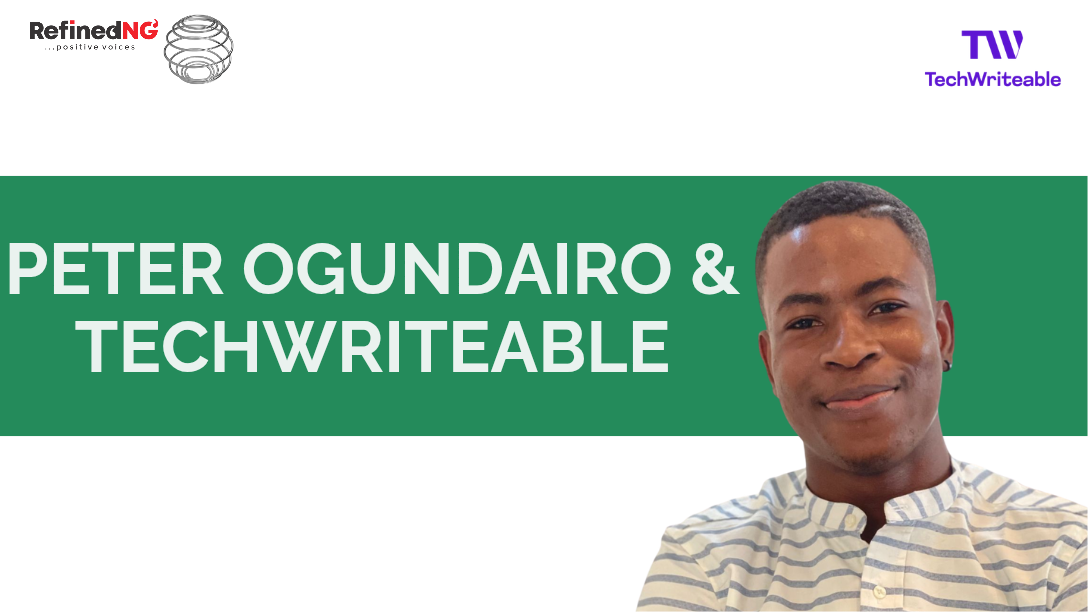
Peter Ogundairo’s content career began with a simple, universal need: money. Seven years and several pivots later, that same practical drive has become the engine behind Techwriteable — a platform Peter describes as “education + brand + opportunity.” What started as a SaaS-focused blog has expanded into an integrated career ecosystem: a place for writers to build verified portfolios, learn market-ready skills, and find vetted jobs.
In this spotlight interview, Peter explains the market problem Techwriteable was built to solve — the “cycle of poverty” in content careers where aspiring writers can’t land better work.
Let’s start with you. Can you tell us a bit about your background and how you first discovered your love for writing, marketing, and storytelling? Was there a particular project or moment that made you realize, “This is what I want to do”?
Peter: My first experience was about seven years ago, and it wasn’t a question of passion, actually, or love. I needed money, and I knew a couple of people who were doing it. I was looking for writing jobs, so I searched a couple of places, tried to join popular platforms like Upwork unsuccessfully.
There was a spark moment, actually, in my job search when I almost gave up, but I read a book that talked about how most people want to achieve something, and then they try a little bit, and then give up. It asked, “Have you really tried? Like, can you say you’ve tried 100%?”
So I ditched the popular channels and went to social media. It was a Twitter search, and I found someone who posted about a job opening, and I applied. They got back to me, offered me to write a couple of pieces on Nigerian celebrities, and that was how my journey started. I remember my first paycheck. I went to eat Amala and soft drinks, like wow, money — it’s good to have your own money. Since then, it was something I continued to do because for me, whatever I’m in, beyond doing the work, I like to get better. I like to feel that I’m better than I was yesterday.
So I started doing that. I worked with several other people, and then in 2020, I started a skincare blog. Interesting. What am I doing in skincare? I was trying to do a little bit of business on the side because I’ve always been interested in business, and that moment of trying to do something much better with my skills did get me in front of an acquaintance who explained a couple of things to me about freelancing and Upwork. He gave some guidance, and I ended up on Upwork.
Later, we started C+ Media. C+ Media was the first company I started. It was sort of like the writing I was doing — trying to scale it with more structure. We did that for a while and got to work with more people, and after a while, I had the first set of tech writing. In 2022, it was my first, even though I’d been in the writing and content industry for a while, and we worked with several companies; I wouldn’t say we were stakeholders in that space. It was more of “We need this thing. Let’s write and bye-bye. If it’s going on, it’s going on. If there’s nothing more to do, then move on.”
Techwriteable was more like “Okay, let’s create a bigger brand out of this thing we’ve been doing for a while. Let’s make a bigger brand and name out of it.” Techwriteable started as a SaaS blog — we created a SaaS blog for SaaS writers where you can write on different topics you’re interested in and also use it to work with companies.
And then from there, it’s been like a lot of light bulb moments that it can be much more, until we got to what Techwriteable is today, which is a mix of an agency portfolio, job board, and an academy for content marketers.
Every solution begins with a problem. What challenges did you personally face as a writer or marketer that made you think: “There should be a platform for this”? Or what gaps did you notice in the writing/marketing space that inspired the creation of TechWriteable?
Peter: First, I’d say what put it as one of the first light bulb moments was with the portfolio.
When we started with Techwriteable, one of the reasons was that we wanted to work for other companies. I had the ones that I’d written a couple of pieces for. But the thing is, if you write for some, they take your content. Some give you credits, while some don’t. Credit in the sense that they publish it on their site and they put your name there, giving you authorship credit.
In the content space, authorship credit is quite important because that is our own CV. At least when it comes to writing, that’s your CV. It’s like saying I’m a programmer and people will ask, “Which app have you built? Which software have you built?”. And content is sort of like this. In writing in particular, it’s sort of a similar instance because in every industry, showing is better than telling. It’s easier to apply for a writing role, and you can present them as part of your CV; “These are my samples.” They even look at your samples first before your CV.
So, I’ve been writing for a while. I’ve written a lot, but some weren’t under my name. I could have done the Google Docs approach, but competition was growing in this space, and I needed a way to stand out
Can you walk us through the story of how TechWriteable started? Was it an idea you nursed for a while, or did it come suddenly from a specific experience?
Peter: I did mention that Techwriteable started as a SaaS blog. I was interested in going into the SaaS space. When we created the first portfolio page, it was more like an author’s page where you put your name, picture, other details, and then the article you’ve written. I saw it then and thought this was something others would definitely need. As a writer, you should be able to say, “I want to go into fintech, I want to become a blockchain writer, I want to become a software writer,” and be able to create your own samples and proof of your work instead of waiting for a company.
It’s kind of a cycle in the sense that to land better opportunities, you need to be able to show that you can do the job. But for you to be able to show that you can do the job, you need to first land the opportunity. That sort of starts a cycle. I have a background in Economics, and I like to make economic references. We call this cycle a cycle of poverty, in Economics, whereby, to make money, you need to have better education or better resources. Because you don’t have that — you’re unable to access better opportunities — so you’re going through the same cycle. And that leads to not having something to showcase.
You want better opportunities, but because you don’t really have something to showcase, you go in circles. So you’re out in a cycle where, as a new person, you probably don’t have the opportunities to write for some of the top brands and so on, or maybe you even have the opportunities, but you’re looking to divert into spaces where you’re not known. Now you can write your own articles on the topics you want and put them on a standard site. You can do medium, Substack — you can do all this. But a lot of companies do not actually take those seriously because anybody can go to Substack or Medium and write anything.
And that was how Techwriteable actually first shifted from something that is a personal site, a personal goal, a personal brand, to something that is meant to be a platform that helps others scale in writing and in the writing space. And we’ve also evolved a lot more since then.
Read: The Balm.co: Giving Women’s Stories the Space They Deserve
What was the early stage like—finding the right team, building the product, convincing others about the idea? Did you face skepticism, and how did you push through?
Peter: Building a startup or a company, especially a tech startup, is a very challenging experience, particularly building around an unusual area like writing or content. You also mentioned things like investors — I’ve not worked with any investors since I started. It has always been bootstrapped — I spent my money and some profits.
To answer the question of challenges, there are a lot of challenges. I usually think that if I knew it was going to be this hard, I doubt I would have started it, because there are many more convenient ways to build a career and earn a living than doing startups. It’s a really, really challenging space.
I’ve also come to realize that there’s nothing that comes out of the blue. Nothing is happening now that’s not happened before, but it’s still a very challenging experience. I’m a big fan of Hollywood; I watch a lot of Hollywood movies, and I know they’ve glorified all these things. I see a lot of people want to become entrepreneurs; they want startup stuff—I know, but trust me, you might even enjoy yourself going to work for someone or a company, or being a partner and all that by finding yourself. And it’s because there are a lot of risks that you have at the start.
Also, you mentioned the team. I’ll put first team risk, there’s market risk, and product risk. I also ask, “Are we building the right thing and are we building it well enough?” There are also industry risks. One of the biggest challenges I’ve faced since starting Techwriteable is that we started at a time when the whole content space is in a state of serious shock with AI and generative AI.
I made a funny post on my social media — I went to my past emails from the people who hired me for my first job. The communication had a lot of grammatical blunders, and these people still hired me, because the bar then was very low. But right now, even AI, just as a tool, can write so well.
So when you say you’re a content person, it’s not about “Oh, I can write.” You need to have a lot of skills out together to make it an actual, valuable content professional in this world. So, yeah, there’s industry competition, there’s a ton of stuff that comes with it, and also, there’s been a lot of challenges. And I found a way to keep going — for different reasons, I found a way to keep going, for different reasons.
For someone who has never heard of TechWriteable, how would you describe what the platform does in the simplest terms?
Peter: I’d say Techwriteable is a career platform for you as a content professional. We are building an ecosystem that provides you with all you need to succeed as a content professional.
I actually have this thing I usually share with the team. This formula that I usually share with the team — which I say is like the success formula for content professionals — is EDUCATION + BRAND + OPPORTUNITY. That’s what it takes for you to succeed as a content professional. So with education, you need to have the right skills. The right in-demand skills that people are willing to pay for. Not just the right skills. And that is what we aim to achieve with the Techwriteable Academy.
Then, beyond having the education, you need to have branding, particularly if you are targeting global opportunities. So you need to be able to package and showcase your work very well. And that is what you have with the portfolio. Then the opportunity is that you need to have access to the opportunities, who is hiring, and how to go about it.
And this is what we are building with the job board and other complementary resources that we’ve put together. So the objective with Techwriteable for content professionals is that career platform that, even as a beginner or an intermediate, or an expert, can propel you to the next level.
What are some of the most exciting success stories you’ve seen—maybe a writer who landed a job, or a project that came to life through the platform?
Peter: Someone did start a trend recently on Techwriteable. She’s a writer by the name Paula Nwadiaro, and she’s been reviewing the content strategy of prominent startups in Nigeria. So, she did one recently on PiggyVest’s content strategy, wrote about it on Techwriteable, and I shared it with their content lead. That’s an example of someone using it to showcase areas they have a writing interest in and using it to land in front of their target audience.
Recently, we had direct postings to the job board from people who are looking for writers, about one or two, because we also share general opportunities directly, and we have those looking to hire directly from Techwriteable as well. Also, we have people we’ve worked with directly, and some have gone on to make over a million. One of the guys who uses the platform made a LinkedIn post recently on how he made his first one million naira in content.
So those are the top three that come to mind right now.
From your perspective, how do you see the state of content writing and digital marketing in Nigeria and Africa today? And what role do you think TechWriteable can play in shaping that ecosystem?
Where do you see TechWriteable in the next 3, 5, or even 10 years? What big dreams are you chasing for the platform and the community it serves
Peter: In Africa, in Nigeria, which is actually close to my heart, I see Techwriteable as an authority in the content space in a few years from now. And not just because I am wishing, but also because I know that it is something that is very important. Over the past six, seven years, since I’ve been in content, I have seen it create an opportunity, a career, and a means of earning for several young people that would not have had any other means.
Now, Nigeria on its own is pretty tough, but we’ve had digital skills. I know that there’s design, coding — not all of us can code anyway. I’ve tried to learn coding unsuccessfully at least four times before I settled in for content. I’ve seen content provide a means of earning and a career for several people.
And then over the past two years, we’ve gone through a transition with AI—generative AI—where there’s been less demand for hiring content professionals. Companies have been cutting back. Everybody thinks ChatGPT can just do the work. I know, and to a very large extent, they are right. ChatGPT can do a lot more.
But what I would put it at is that there’s still a great opportunity for content professionals in Nigeria, in Africa, to earn a living. I’ve seen several people run away from content over the fact that these things are happening. But there’s still an opportunity, and now the difference is that the game has changed. The barrier to entry is higher. Now, coming in and saying “I can write” or saying you can string words together, you believe you can write, that is no longer valued in today’s world.
You need to understand it from a strategy level, how it contributes to companies, and all other components of being a standard writer, writing professionally, and standard content professionally. Perhaps learn how to use these tools, how to do SEO, and learn how to do storytelling or research. Because, like I stated, the barrier to entry, what it means to be a professional that companies are willing to pay good money for, is much higher than anything else.
These companies will ask “why should we pay you?”, and in Africa, in Nigeria, there’s no structured place—structured community, structured platform — that brings people into this new era, that educates people into this era. You see a lot of people running away even before the era of ChatGPT. I did that for a while — saying ‘Let me find another job or maybe a 9-5.’
To answer your question, Techwriteable in Africa, I would say that becoming an authority and providing a platform where you get to learn the latest skills. That means to be a professional that makes you employable locally and internationally. And of course it doesn’t just stop with education, even through the opportunities, through the branding, we are consistently improving to make sure we can do better in this world.
And just as a side piece, I noticed that a lot of people come into content, maybe it helps them to make money in school, or they did it for a while, and they go find another job. That’s because a lot of people in Nigeria, in Africa, do not see a career path in content. For the majority, more than 90%, content stops at writing. Meanwhile, writing is at the entry level in content. You can actually advance. You can become an SEO professional or a Content Strategist. If you want to explore other complementary areas, you can definitely become an email marketing professional, a senior copywriter.
For instance, banks want people who can write their ads, campaigns for them, which is a big industry in other parts of the world. And one of the goals we also have is to expose this long-term career path to a lot of people in this part of the world so that they can do more in the space they are already comfortable with. It doesn’t have to stop. If you can earn a good living, do very well as a junior content writer, imagine how much more you can do as a professional who even has that elementary skill with some other strategic and advanced ones.
Running a startup is no small feat. What have been your biggest lessons as a founder so far—both personally and professionally?

Peter: Well, I think there’s been a lot of lessons, but one that stood out for me recently, and I’d say guides my decisions, is to remain very, very adaptable. Both as an individual, as a team, and as a company. And that’s because the world will change, the world will always evolve, and you need to learn to evolve with it or you’re going to be left behind.
Today, I answered one of your questions, which is how Techwriteable helps content professionals. We have an arm of Techwriteable where we serve companies. What we did for a long time was writing, but the companies are demanding much more these days. You need to be able to top it up with some advanced things, and that’s something we’ve had to pick up as a team and as a company. And the same applies to writers themselves.
I’ve seen a lot of people running away from writing, with claims of no job opportunities. No, there are opportunities, and companies have started hiring as well. I don’t know if you saw a post recently on social media that OpenAI is hiring an SEO professional. They’re also hiring content strategists, but they’re not hiring content writers.
They’re also hiring SEO professionals, content strategists. So for most writers in this space, if you upskill, learn more advanced things with what you already have as a writer, you are going to move once again from someone companies are not hiring as much to someone they want. Right now companies want SEO professionals, people who actually do SEO, using these tools, do keyword research, infuse them into great articles, and do storytelling.
It’s important to remain adaptable. People will read content online. Whether it’s ChatGPT or others, people will always read content online. Content is always going to exist. Written work is always going to exist, but the process of creating it, sharing, and even consuming it will change over time. And that is why you have to always remain adaptable to stay on top of things and not be left behind.
Right now, Techwriteable is in the process of a rebrand, and we are updating some of our site information so that people know it’s not just writing. Working is still a very strong and core part of what we do, but we are expanding to other areas of content, both vertically and horizontally.
So, vertically in the sense that, if you’re a content writer, then a senior content writer, then an SEO writer, then a content strategist, and so on. Horizontally in the sense that we’re looking at social media, email marketing, web, and other channels. We’re looking at all those different channels, and we want to be known as a hub for content professionals as a whole, not just content writers.
Read: Lagos Hustle Diaries: Through the Eyes of a Sports Storyteller
What’s one surprising thing about you that people might not expect?
Peter: I guess I like to watch educational musicals on TikTok. If I showed you the videos, you would understand. It’s sort of like this lady who’s always singing about random stuff—maybe the sun or something else. It’s like reading a textbook, but they’re singing.
If you watch musicals—proper Hollywood musicals where they’re performing and it’s a movie —she does it that way. I find it very amusing. If you are beside me whenever I’m playing the videos on my phone, you would be like, “What is this guy listening to?”.
I don’t know if that’s interesting anyway, but I’ve gotten a few funny reactions from people when they see me doing it.
Do you have any final words for anyone who is looking to break into the content space or someone looking to build a career in this space?
Peter: Before I go into that, I want to commend what RefinedNG is doing, spotlighting these stories and sharing them. I think in this part of the world, we need a lot of people sharing these stories, and it’s important to highlight the opportunities because people need to know. I think a lot of people do not know. They do not see the opportunities. They don’t know that a lot of things are even possible.
I consider myself quite fortunate given my experiences. Who knew I could have landed in what I was doing for a while and then got to do so much with it, and I know several other people like that as well. Then, when you have conversations with some people about what you do, and you respond with “writing,” they’re left wondering.
So yeah, well done. I’m looking forward to more of this. For anybody who is doing something worthwhile, I also know it’s not easy. It can be very challenging. I’ve been seeing notifications of RefinedNG for a while, so I know you have been around for a while, and you still have this going on. So, well done.
To answer your question, for a new person getting into content, I would say start with the fundamentals and find a community. I’m going to touch base on both.
I’m saying start with the fundamentals because when we picked up content writing, it was like a form of marketing through storytelling. So you have a product or business, and you want to talk about it on social media, on your website, or on other channels. It was a form of storytelling to put yourself out there, attract your target audience, and customers.
A huge part of the work, then, before generative AI was doing research and rewriting. I’d say 60% of the work. But with generative AI, the process of writing and even some parts of research have been made much easier. And now, it is not as much of a big deal as it was before. The new big deal is being able to tell great stories, put them together in a compelling way, in a great way, and then using these tools.
The best way to do that is to understand the fundamentals, why you write the content itself, and who this content is for, instead of jumping in and saying I’m a content writer. Be sure you understand the whys and the fundamentals and principles.
Now the community. Things are sort of settling down for a bit. A lot of companies ran away from content before. Now people are seeing the limitations of AI, but even AI is not chilling. AI itself is advancing.
I used ChatGPT two weeks ago, and I can tell you it’s not the same as it was three weeks ago. It has gotten so much better in writing within those three weeks that I used it. Before, if I created content on ChatGPT, I’d have to take it to Claude or maybe write it myself to make it clear. Now, on its own, ChatGPT has improved. Even Google, social media platforms — everyone is adjusting, and you don’t want to be lost in a sea of information.
So find yourself a good community where you can find relevant, factual information on what to learn, what to do next, and how best to position yourself. Once you understand the fundamentals and you’re in the right environment, the next steps will naturally reveal themselves in building a thriving career for yourself.