
Nigeria’s Super Falcons have once again proven why they remain the queens of African football — sealing qualification for the 2026 Women’s Africa Cup of Nations (WAFCON) with a 3–1 aggregate win over Benin Republic.
The Falcons played out a 1–1 draw with the Amazons of Benin in the return leg on Tuesday at the MKO Abiola Stadium in Abeokuta, Ogun State. But having already won 2–0 in the first leg held in Lome, Togo, Justin Madugu’s side had done just enough to book their ticket to Morocco — the host nation for next year’s tournament.
Plumptre’s First Goal Gives Falcons Early Edge

It was a night of mixed emotions in Abeokuta as defender Ashleigh Plumptre opened the scoring for Nigeria in the 13th minute — heading home a powerful corner delivered by Esther Okoronkwo. The goal was particularly special, marking Plumptre’s first-ever goal for Nigeria since switching allegiance from England in 2017.
Her strike electrified the home crowd, with chants of “Super Falcons!” echoing across the packed stadium. But the Beninese Amazons were far from intimidated. They held their ground, pressed high, and displayed impressive composure for a side facing the ten-time African champions.
Read: Super Falcons Defeat Benin in WAFCON Qualifiers
Benin Fights Back — But Nigeria Holds Firm
The visitors found their rhythm after the break. Their persistence paid off in the 61st minute when Yasmine Djibril curled in a superb free-kick to level the scores. For a moment, the Falcons looked vulnerable as Benin pushed for another goal, but goalkeeper Chiamaka Nnadozie made several vital saves to keep Nigeria in control.
Substitute Folashade Ijamilusi and captain Rasheedat Ajibade both came close to restoring Nigeria’s lead, but Benin’s keeper Sourakatou Alassane denied them brilliantly. The game ended in a tense 1–1 draw — enough for the Falcons to advance with a comfortable 3–1 aggregate victory.
From Lome to Abeokuta — Job Done
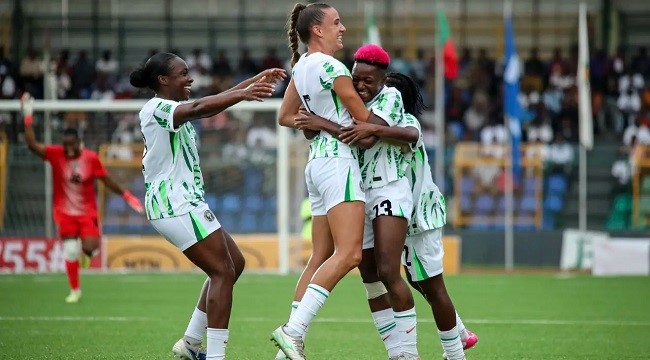
The Super Falcons’ journey to qualification began in Lome, where goals from Okoronkwo and Chinwendu Ihezuo gave Nigeria a solid 2–0 first-leg win. That early cushion allowed Madugu’s team to approach the second leg with more tactical control, using the home crowd’s energy to secure progression.
It was also a moment of reflection for the team, who last lifted the WAFCON trophy in 2018, having previously dominated the tournament in 1998, 2000, 2002, 2004, 2006, 2010, 2014, and 2016. Their record — 10 titles in 13 editions — remains unmatched on the continent.
Eyes on Morocco and BeyondNext year’s WAFCON will be held between March 17 and April 3, 2026, in Morocco. It will also double as the African qualifier for the 2027 FIFA Women’s World Cup in Brazil. The four semifinalists will automatically qualify for the global tournament, while two additional teams will compete in intercontinental playoffs.
For Nigeria, qualification represents more than just another trophy chase. It is a statement of continuity — proof that the nation remains Africa’s strongest force in women’s football, even as other teams grow more competitive.
With a talented squad led by Ajibade, Oshoala, Plumptre, and Nnadozie, the Falcons are not only defending champions but also ambassadors of Nigerian resilience and pride.
As head coach Justin Madugu put it after the match, “This team knows what it means to wear the green and white. Every game is a reminder that we carry the dreams of millions of Nigerians, home and abroad.”