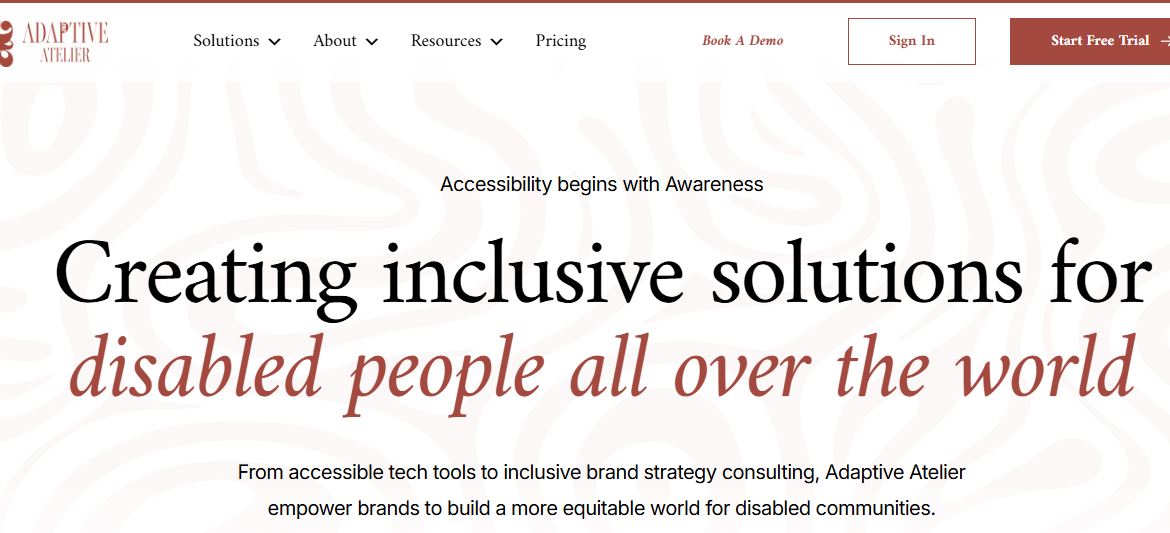
Most digital platforms are designed with an invisible assumption: everyone experiences the internet the same way. Scroll speed. Colour contrast. Navigation flow. Audio cues. Tiny buttons. Flashing animations. The average user rarely notices these decisions. But for millions of people living with disabilities, they can determine whether a website feels usable or completely inaccessible. That is the problem Adaptive Atelier is tackling.
Founded by Nigerian entrepreneur, Toyosi Badejo-Okusanya, the global branding and accessibility consultancy is building tools that help websites, apps, and digital platforms become genuinely usable for people with disabilities.
But beyond compliance checklists and accessibility widgets, the company is pushing a much bigger idea: accessibility is not a side feature. It is digital infrastructure.
Read: ChipMango: The Missing Layer in Africa’s Tech Story
The Real Barrier Is Often Invisible Design Thinking
Many startups proudly describe their products as “user-friendly”. The problem is that the definition of “user” is often painfully narrow. Across Africa’s fast-growing tech ecosystem, products are usually built mobile-first and speed-first. Teams obsess over growth metrics, onboarding funnels, and sleek interfaces. Accessibility, when mentioned at all, is frequently added later as a patchwork feature.
Adaptive Atelier challenges that mindset directly.
For Toyosi, the mission is deeply personal. Growing up deaf in Nigeria, she experienced firsthand how systems often misunderstood disability rather than accommodating it. What looked like stubbornness to others was actually exclusion hiding in plain sight.
That perspective shaped how Adaptive Atelier approaches product design today. The company focuses not only on visually impaired users or captions for videos, but also on people with ADHD, dyslexia, autism, epilepsy, motor impairments, and cognitive disabilities who are routinely ignored in mainstream product conversations.
In many ways, Adaptive Atelier is asking African tech companies a difficult but necessary question: who gets excluded when convenience becomes the priority?
Adaptive Atelier Is Building a Participation Layer for the Web
What makes Adaptive Atelier interesting is that it does not simply diagnose accessibility problems. It actively reshapes digital environments around user needs.
Its product, AdaptiveWiz, allows users to personalise how they experience websites in real time. Someone with low vision can adjust contrast and font size. A neurodivergent user can simplify layouts. Users sensitive to motion can reduce animations and visual triggers.
Instead of forcing people to adapt to rigid interfaces, the platform allows interfaces to adapt to people. That philosophy extends into AdaptiveTest, the company’s monitoring engine that continuously scans platforms for accessibility issues like keyboard navigation failures, missing alt text, and structural design flaws.
But the most overlooked part of Adaptive Atelier’s model may be its human layer.
Rather than relying entirely on automated testing, the company works with disabled professionals who provide real-world usability feedback. That creates something rare in tech: a system where accessibility testing also becomes economic participation.
In a country where unemployment rates remain disproportionately high among people with disabilities, Adaptive Atelier is not only designing inclusive platforms. It is helping create paid pathways into the digital economy itself.
Read: Daliso Ngoma’s Mission to Make Africa Feel the Future
Why This Conversation Will Matter More in the Future
Accessibility is often framed like charity work or regulatory compliance. Adaptive Atelier sees it differently. It sees accessibility as the next expansion layer of digital growth.
As AI becomes more embedded into everyday products, adaptive experiences will become increasingly important. Platforms will need to respond intelligently to different physical, sensory, and cognitive needs instead of assuming one interface works for everyone.
That shift creates a major opportunity for African startups and digital businesses.
The companies building accessible systems early will likely serve broader audiences, improve customer retention, and future-proof their products as global accessibility standards tighten.
Adaptive Atelier is positioning itself at the centre of that transition, steadily, and from an angle many companies still underestimate. Because the future of technology may not simply depend on how advanced digital systems become. It may depend on how many people those systems finally allow to participate fully.
Stay connected with RefinedNG for more stories spotlighting African innovators building smarter, more inclusive systems for the future.