

October 5 marked World Teachers’ Day 2025, and if there’s one truth that bears repeating, it’s this — teachers are the quiet architects of our futures. Beyond classrooms and lesson notes, they build dreams, shape confidence, and hold up the very foundation of society.
Yet, in a world that often overlooks their value, one woman is making it her mission to ensure teachers never give up on the calling that keeps nations alive. Aroloye Oluwatosin, founder of Olùkọ́ and Techy Teacher Academy, is leading a movement to reimagine what it means to teach in Africa — empowering educators with digital skills, financial literacy, and community support.
We sat with her to talk about her journey, her passion for reform, and why she believes that when teachers rise, every other part of society follows.
You’ve built your life around education, but let’s start from the very beginning. What first sparked your passion for teaching, and how did that evolve into becoming an advocate for teachers?
Oluwatosin: My passion for education began at a young age. Growing up, I saw how the quality of a teacher could shape not just academic outcomes but a child’s sense of possibility. That early exposure planted a deep conviction in me that education is not merely a profession it’s nation-building.
As I progressed in my teaching career, I began to notice a gap: while teachers were at the heart of transformation, they were often left voiceless, under-supported, and under-valued. This realization moved me from simply teaching in classrooms to advocating for teachers as change agents, using my voice and platforms to highlight their challenges, celebrate their resilience, and push for systemic reform.
That’s powerful — and it sounds like your “why” came from a place of deep observation. But was there a moment when it stopped being just passion and became a mission? A point where you told yourself, “Something has to change, and I’ll be part of it”?
Yes. For me, the turning point came after I watched passionate, skilled teachers leave the profession not because they lacked calling, but because the system made survival difficult. Many were overwhelmed by poor pay, lack of growth opportunities, and societal disregard.
One conversation with a fellow teacher who broke down in tears over financial struggles stuck deeply. In that moment, I made a personal commitment:
“I can’t fix the entire system overnight, but I can start creating spaces where teachers are seen, heard, equipped, and valued.”
That commitment became the seed for initiatives like Olùkọ́ and Techy Teacher Academy.
Read: Peter Ogundairo: From Paychecks to Portfolios at Techwriteable
You studied Early Childhood Education, which is such a formative area. How has that background shaped the way you think about reforming — and even humanizing — education in Nigeria today
Oluwatosin: My background in Early Childhood Education taught me to approach education with a human-centered lens. I understand that education is not just about instruction; it’s about connection, curiosity, and the environment that nurtures growth.
This background has shaped my vision for reform in two key ways:
- Prioritizing the teacher’s well-being, because no educational system can rise above the quality of its teachers.
- Championing play-based, inclusive, and empathetic learning approaches that see every child as capable, creative, and worthy of investment.
Let’s talk about Olùkọ́. It’s grown into a strong community across Africa, but how did it all begin? Was there a specific moment that made you realize teachers needed a platform like this?
Oluwatosin: Olùkọ́ was born out of countless conversations with teachers who felt unseen and disconnected. I realized that while they were individually doing powerful work, there was no central platform amplifying their voices or connecting them to opportunities for growth.
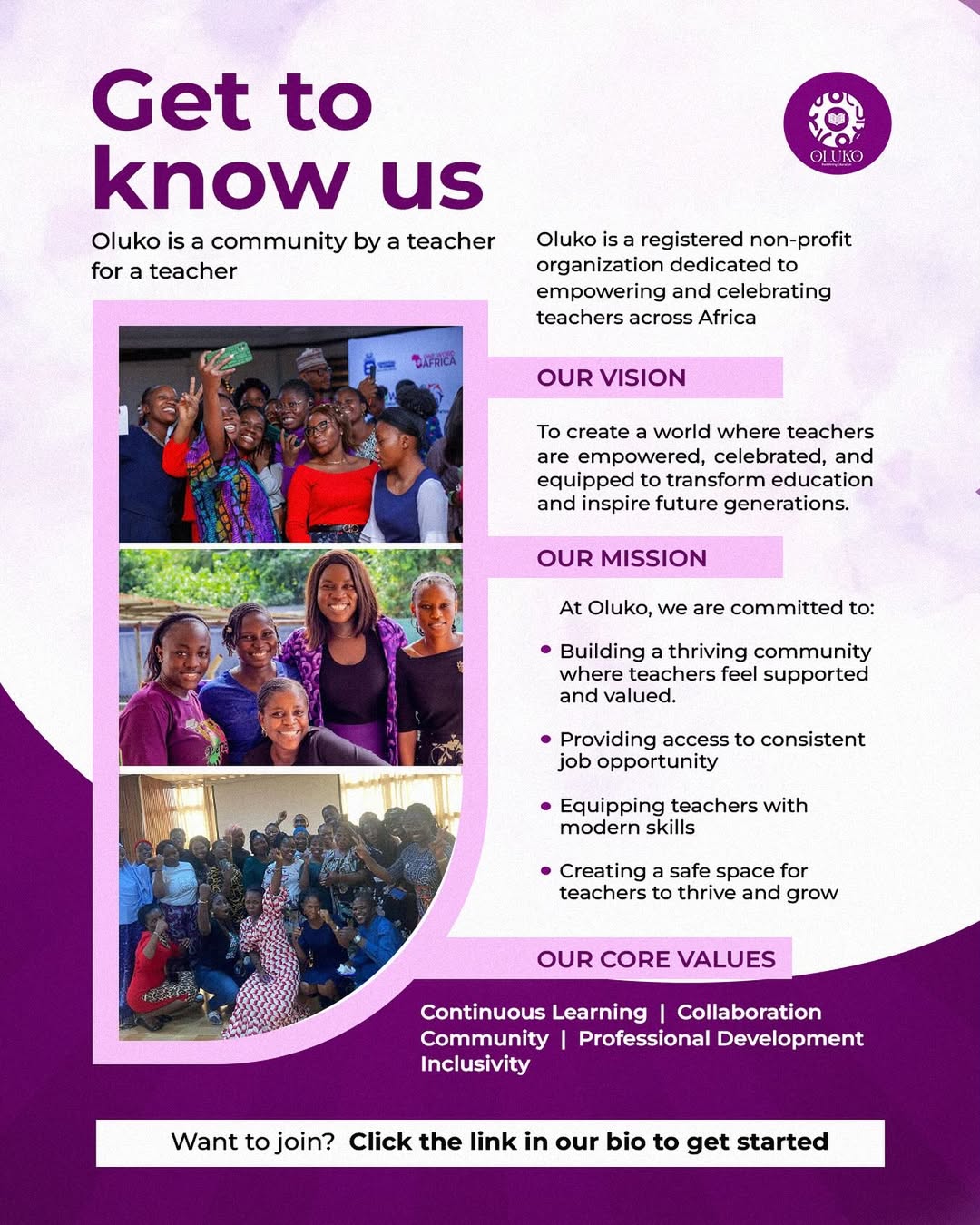
The turning point came during the COVID pandemic, when digital spaces became lifelines. I started hosting conversations, creating resources, and highlighting teachers’ stories. The response was overwhelming. Teachers wanted community, visibility, and practical support. What started as a few conversations has now become a movement uniting teachers across Africa under a shared vision of dignity and empowerment.
You speak to teachers every day, across different backgrounds and contexts. From those conversations, what challenges come up the most — and how is Olùkọ́ helping them overcome these struggles?
Oluwatosin: The most consistent struggles teachers share include financial instability, lack of professional development, burnout, and limited access to digital tools.
Through Olùkọ́, we have addressed these in tangible ways:l, by building community support that breaks isolation and creates peer learning spaces, organizing capacity-building programs that equip them with practical skills, leading advocacy campaigns that challenge narratives and push for better policies, and importantly, platforms for visibility.
Because being seen often opens doors to opportunities teachers never imagined.
Now, let’s talk about technology — because you’ve also built Techy Teacher Academy. In your view, why are digital skills so essential for today’s teachers?
Oluwatosin: Today, digital literacy is not optional. It’s essential. The classroom has expanded beyond four walls, and teachers who can navigate digital tools hold the power to reach more learners, diversify their income, and shape narratives at scale.
Through Techy Teacher Academy, we’re equipping educators to not only survive in the digital era but thrive as innovators, creators, and thought leaders. Our mission is to ensure teachers don’t get left behind in a rapidly changing world.
And beyond the big vision, there are always personal wins that make it all worth it. Is there one teacher’s story that really stayed with you — someone whose journey reflects what Techy Teacher Academy is all about?
Oluwatosin: Yes, there are many, but one stands out. A teacher who joined Techy Teacher Academy with zero digital skills went on to build a thriving online tutoring business within months. She began by learning basic tools, then grew confident enough to create content, attract students from outside Nigeria, and triple her income.
For me, this story represents what’s possible when teachers are given the right tools and community transformation that ripples from their personal lives into their classrooms.
One thing that stands out about your work is how holistic it is — you don’t just focus on professional skills, but also on financial empowerment. What inspired Save-a-thon, and how has it changed the way teachers think about money and stability?
Oluwatosin: Save-a-thon was born out of a hard truth: many teachers were struggling not just with low income but with financial habits that limited growth. I launched the initiative to help them build savings culture, develop financial discipline, and create safety nets.
Since its inception, teachers have shared powerful testimonies of consistency with savings and finally feeling a sense of financial control. For me, it’s not just about money; it’s about restoring agency to teachers.
That’s so interesting. How have you seen that financial confidence translate back into classroom performance and motivation?
Oluwatosin: When teachers are financially confident, they show up differently. I’ve observed that financial stability breeds focus, creativity, and motivation. Teachers who are not weighed down by financial stress are more present, innovative, and passionate in their classrooms.
This reinforces my belief that teacher empowerment must be holistic financial well-being is a critical part of educational reform.
Read: The Balm.co: Giving Women’s Stories the Space They Deserve
You’re not only changing the game locally but also driving conversations through initiatives like the African Teachers Summit. What’s your long-term vision for teachers in Africa over the next decade?
The vision is bold yet clear: to see African teachers become globally respected, digitally empowered, financially stable, and socially influential. I imagine a continent where teachers are not at the mercy of systems but are shapers of systems, leading conversations, innovating, and setting the pace.
Through summits, programs, and platforms like Olùkọ́, we’re working to build this future, one empowered teacher at a time.
And if you could shift one thing about how society views teachers today, just one thing, what would it be — and why does that matter so much to you?
If I could change one thing, it would be the narrative of pity and low expectations. Too often, teachers are seen through the lens of struggle rather than power and potential. I want society to see teachers as nation builders, innovators, and influencers, deserving of respect, investment, and support.
Finally, for young educators and education students who look up to you and your work, what’s your advice for building a career that’s both fulfilling and impactful?
My advice is simple:
“Don’t wait for the system to validate you before you rise. Start where you are, use what you have, and stay rooted in purpose.”
I also want to encourage young educators to embrace technology, build communities, keep learning, and be visible. The world needs their voices, creativity, and courage now more than ever.