

When Dr. Varaidzo “Vee” Kativhu began her PhD defence at Claremont Graduate University, the audience looked nothing like the small gatherings that usually mark the end of a doctoral journey. Instead of a quiet academic room, thousands of people were waiting.
More than 3,200 p,eople from 46 countries registered to watch her two-hour dissertation defence live. At the height of the session, 2,620 viewers joined simultaneously, logging in from the United Kingdom, the United States, Nigeria, South Africa, Canada, Kenya, Australia, France, Jamaica, Germany and several other countries.
Twenty-two people physically attended the defence. Everyone else filled a Zoom room that university administrators later confirmed had never hosted that number of viewers for a doctoral defence.
Kativhu, a 27-year-old British-Zimbabwean researcher, made the decision to livestream the event herself. Academic defences often happen behind closed doors, with only a small number of faculty members and invited guests present. She chose a different route.
Her research focuses on access and representation in higher education. Opening the defence to the public matched the very issues her work examines.
Read: KollegeScout and Fiyinfoluwa’s Vision for African Students
Researching the Experiences Behind Elite University Admissions
Kativhu’s dissertation, titled “Beyond Access: Black Women Alumnae’s Perspectives on Navigating Russell Group Universities as Undergraduates in the UK”, explores what happens after Black women gain admission into some of Britain’s most prestigious universities.
Public discussions around elite universities often focus on admissions statistics and entry opportunities. Her research shifts attention to the lived experiences that follow acceptance letters.
The study draws on the perspectives of Black women who attended Russell Group universities, a network of leading research institutions across the United Kingdom. Through their stories, the research examines the academic pressures, social environments and institutional structures students navigate once they arrive on campus.
By opening the defence to a global audience, Kativhu created space for the communities connected to that research to witness the conversation directly.
The response was immediate. Students joined from multiple time zones, some watching late into the night. PhD candidates said the event renewed their motivation to finish their own research. Black women working in academic spaces shared messages about the significance of seeing someone present research that reflected their own experiences.
One viewer wrote that opening the defence helped make academic research more accessible to people outside universities. Another described the moment as powerful simply because it allowed people to watch a Black woman present her expertise with confidence and authority in a space where representation is still evolving.
Read: IWD: Meet Dr. Nneka Mobisson, Advancing Digital Health in Africa
From Oxford Student to Global Education Advocate
The defence concluded with a unanimous decision from her committee. The panel, chaired by Dr. Thomas Luschei, alongside Dr. Frances Gipson, and Dr. Torie Weiston-Serdan, confirmed that she had successfully completed the process.
With that decision, Dr. Varaidzo Felistus Kativhu officially earned her doctorate in education leadership.Her academic journey spans several of the world’s most respected institutions. She studied Classical Archaeology and Ancient History at the University of Oxford before completing a master’s degree in International Education Policy at Harvard University.
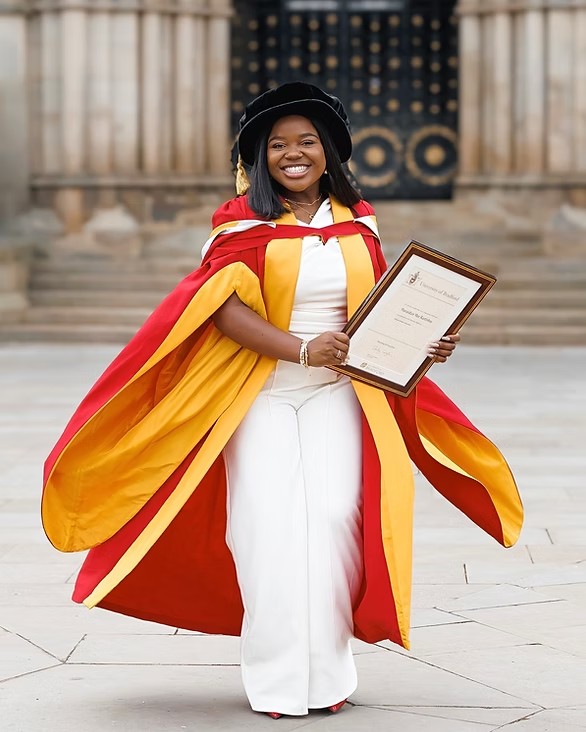
In 2024, she also became the youngest recipient of an honorary doctorate from the University of Bradford.
Beyond Academics
Beyond the academic world, Kativhu has built a global platform around education and youth empowerment. She founded Empowered By Vee, a charity that supports students from underrepresented and disadvantaged backgrounds as they pursue higher education opportunities.
Through workshops, mentorship programmes and online resources, the organisation works with students between the ages of 16 and 25, helping them build confidence, prepare for university applications and access opportunities that might otherwise feel out of reach.
Her work has earned recognition across several global platforms. Kativhu has been named a United Nations Young Leader for the Sustainable Development Goals, featured on the BBC 100 Women list, and recognised as a British Vogue Force for Change. She is also the author of Empowered: Live Your Life with Passion and Purpose, a book focused on helping young people shape purposeful academic and career paths.
Still, the moment that drew worldwide attention this year was the defence itself.
Opening the process to thousands of viewers sparked a wider conversation about how academic knowledge is shared and who gets to witness it being produced.For many who tuned in, the event represented more than the completion of a doctorate. It offered a rare look inside a milestone that usually happens far from public view.
Stay Updated With RefinedNG
At RefinedNG, we continue to spotlight Africans and members of the diaspora who are driving meaningful change across education, business, technology and culture.
Follow RefinedNG for more stories highlighting the people shaping conversations and building impact across the continent and beyond.