
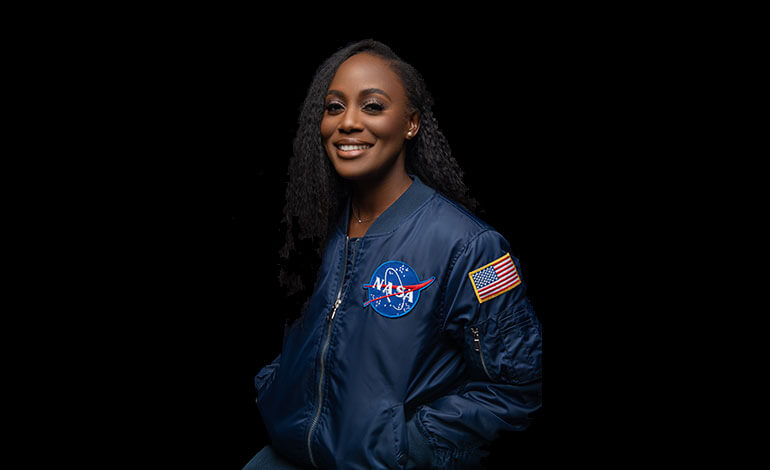
At 26, Wendy Okolo made history. She became the first Black woman to earn a PhD in aerospace engineering from the University of Texas at Arlington. Today, she works at the NASA Ames Research Centre in Silicon Valley, leading research that makes aircraft smarter, safer and more efficient.
Wendy Okolo is not just building a career in aerospace engineering. She is shaping how advanced flight systems are designed, monitored and improved. Her journey moves from Lagos classrooms to high-level research at NASA, and every step reflects discipline, technical depth and clear leadership.
From Lagos Classrooms to a Historic PhD.
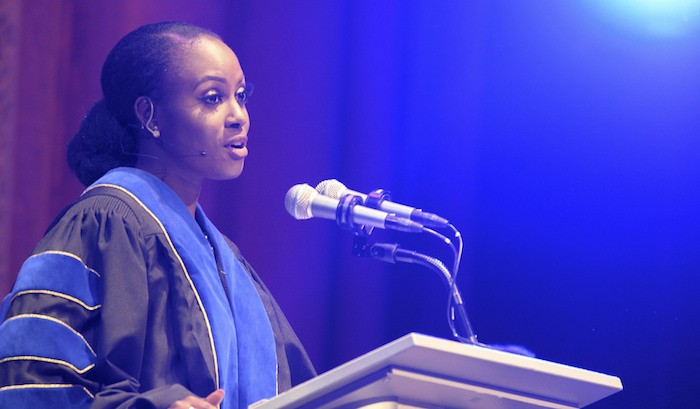
Okolo began her academic journey at Queen’s College, Lagos, one of Nigeria’s leading all-girls secondary schools. She excelled early and developed a strong foundation in mathematics and science. That foundation carried her to the University of Texas at Arlington, where she earned a bachelor’s degree in aerospace engineering in 2010.
During her undergraduate years, she did more than attend lectures. She served as president of the Society of Women Engineers, building leadership skills alongside technical competence. She then pursued a PhD in aerospace engineering under Professor Atilla Dogan.
In 2015, at age 26, she completed her doctorate and became the first Black woman to achieve that distinction at the university. Her research attracted major recognition. She received the U.S. Department of Defence National Defence Science and Engineering Graduate Fellowship, the Amelia Earhart Fellowship and awards from the Texas Space Grant Consortium and the American Institute of Aeronautics and Astronautics. She built credibility early, on merit.
Read: From Classroom Assignment to $11.5M Breakthrough: The Story of Eniola Shokunbi
Engineering the Future at NASA Ames Research Centre

At NASA Ames, Okolo works in the Intelligent Systems Division as an Associate Project Manager and research engineer within the Discovery and Systems Health Technology group. Her focus sits at the intersection of aerospace vehicle controls and systems health monitoring.
In simple terms, she designs and refines systems that help aircraft detect issues, optimise performance and operate more safely. Systems health monitoring allows engineers to predict faults before they become failures. Control optimisation ensures aircraft respond precisely and efficiently in complex conditions.
NASA has recognised her contributions at the highest levels. She received the NASA Exceptional Technology Achievement Medal, the NASA Ames Researcher or Scientist Award and the NASA Ames Early Career Researcher Award. She became the first woman to receive the Ames Early Career Researcher Award. These honours reflect both technical innovation and measurable impact.
Her work does not happen in isolation. She leads cross-functional teams, aligning engineers, researchers and programme stakeholders toward shared outcomes. That leadership dimension defines the next phase of her career.
From Lockheed Martin to the U.S. Air Force: Building Technical Depth
Before NASA, Okolo gained experience inside some of the most advanced aerospace environments in the United States. As an undergraduate, she interned at Lockheed Martin, contributing to work on NASA’s Orion spacecraft, the crew exploration vehicle designed for missions beyond low Earth orbit. She supported both systems engineering and mechanical engineering teams.

As a graduate student, she joined the U.S. Air Force Research Laboratory at Wright-Patterson Air Force Base. There, she worked on aircraft formation flights to reduce fuel consumption. She implemented unconventional trim and control mechanisms to improve fuel savings for trailing aircraft. Her research progressed beyond theory. The U.S. Air Force conducted flight tests that achieved measurable fuel savings.
She also worked at Lockheed Martin’s Advanced Development Programs, often known as Skunk Works, where she implemented performance-optimising control systems for the F-35C aircraft under the U.S. Naval Air Systems Command. Each role deepened her technical range and strengthened her systems-level thinking.
Read: How Nelly Chatue-Diop Built Africa’s First Non-Custodial Crypto Platform
Leading Inclusion in STEM and Expanding Representation
Technical excellence defines one part of Okolo’s career. Institutional leadership defines another. At NASA Ames, she served as Special Emphasis Programs Manager for Women, focusing on recruitment, retention and advancement.
Okolo introduced practical initiatives. She created nursing rooms to support working mothers transitioning back to work. She analysed job descriptions to remove gendered language that could discourage female applicants. NASA Ames recognised this work with an Honour Award for her data-driven approach to inclusive excellence.
Her impact extends beyond NASA. She received the Black Engineer of the Year Award as the Most Promising Engineer in the U.S. Government and was named among the Most Influential People of African Descent in 2021. Through keynote speeches and panels, she consistently emphasises that opportunity in STEM must remain open and accessible.
Setting the Standard in Aerospace Engineering
Wendy Okolo represents more than a milestone. She demonstrates what sustained preparation, rigorous research and intentional leadership can achieve at the highest levels of aerospace engineering. From Lagos to Silicon Valley, she has built a career defined by competence and contribution.
Follow RefinedNG for more in-depth spotlights on African excellence shaping global industries, and share this story to keep these achievements in focus.