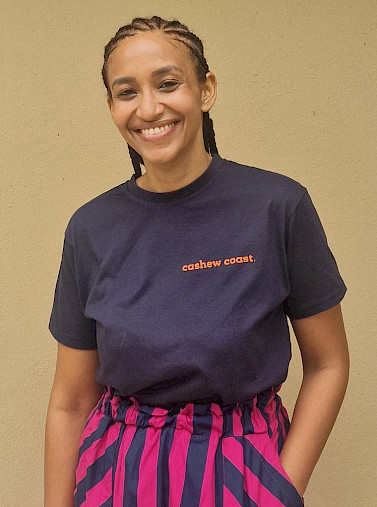
Salma Seetaroo did not plan to become a cashew entrepreneur. She was brought in as an adviser, tasked with helping evaluate a struggling cashew factory near Abidjan, Côte d’Ivoire. She looked at the business, assessed the opportunity, and then did something most advisers do not do. She stayed.
What she had seen was too significant to walk away from. Côte d’Ivoire grows nearly half the world’s cashews. And yet almost all of them were leaving the country raw, shipped to Asia for processing, and then sent back across the world to European and American markets as finished products. The jobs, the value, the profit, all of it was being exported along with the raw nuts. The country producing the most cashews in the world was capturing almost none of the economic benefit.
In 2018, Salma became CEO of what would become Cashew Coast and set about changing that equation.
The Model That Is Simple to Describe and Hard to Execute

Cashew Coast operates on a principle that sounds straightforward: source from smallholder farmers in West Africa, process the cashews at origin, and deliver fresh, fully traceable kernels directly to European buyers in weeks rather than months.
Read: Charles Antwi-Boahen Built Kab-Fam by Learning to Sell Before He Learned to Build
In practice, building that supply chain required solving a series of interconnected problems simultaneously. Sourcing from smallholders means working with thousands of individual farmers across a fragmented agricultural landscape.
Processing at origin means running a factory to international food safety standards in an environment where infrastructure and supply chain complexity create constant pressure. And delivering to major European supermarket chains means meeting the kind of traceability and quality requirements that leave very little room for error.
Salma built it anyway. Over the years since 2018, she doubled the factory’s processing capacity and grew the farmer network from 8,000 to 12,000 suppliers. Cashew Coast now sells to major supermarket chains across Europe, positioning itself directly in the path of the continent’s rising demand for plant-based and vegan food products, a market where cashews, as a dairy substitute, are increasingly in demand.
The company’s approach to pricing is worth noting specifically. Cashew Coast guarantees farmers the minimum government price for their raw nuts, removing the price volatility that makes agricultural income so unpredictable for smallholders. It also works to insulate its European buyers from the same volatility on the supply side. The business sits deliberately in the middle, absorbing complexity so that both ends of the chain can operate with more certainty.
What Traceability Actually Means in Practice
One of the things that sets Cashew Coast apart in a crowded market is its emphasis on traceability and the company has had to build real infrastructure to back that claim up.
When a European supermarket asks where a product comes from, the answer from most suppliers involves layers of intermediaries that make the question genuinely difficult to answer. Cashew Coast can answer it directly, because it controls the supply chain from the farm to the finished product. Some buyers want certified organic. Others want conventional products with full traceability, and are willing to pay a premium for the assurance. Cashew Coast has built the capacity to serve both.
The experimental farm it is currently developing, testing different cashew varieties, spacing, irrigation, and fertilisation approaches from a smallholder economic perspective, is an extension of the same logic. If the company can identify what actually works for small-scale farmers in West Africa, that knowledge becomes a resource for the entire sector, not just Cashew Coast’s own supply chain.
Read:Why Seun Rasheed Chose Rwanda to Build a Thriving Agribusiness
Why This Matters Beyond One Company
Africa is full of industries where the raw material leaves the continent and returns as a finished product, with the value created somewhere else entirely. Cashew Coast is one of the clearest examples of what it looks like to interrupt that pattern deliberately and build something that keeps value on the continent.
Salma Seetaroo walked into a failed factory in Côte d’Ivoire and saw something worth building. Almost a decade later, the farmers in her network are earning more predictable income, a West African factory is producing to international standards, and European consumers are buying a product that was grown, processed, and packed on the continent that produced it.
That is not a small thing. And it is exactly the kind of story the African agricultural sector needs told more often.
Follow RefinedNG for more stories on African business, agriculture, and the entrepreneurs building industries that last. Visit us at www.refinedng.com or subscribe to our newsletter to stay connected.