

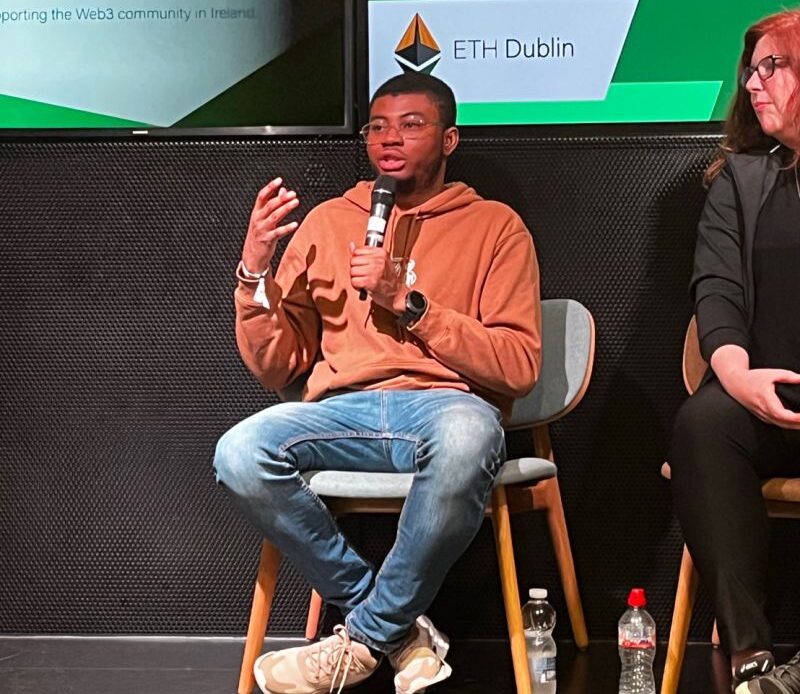
Shalom Osiadi didn’t start in banking. That, he says, is exactly why he could see what banking had missed.
Every founder building African fintech eventually tells some version of the same story: a business loses money not because it failed at its craft, but because the naira moved while it wasn’t looking. For Shalom Osiadi, founder of Esca, that observation wasn’t a pitch-deck line. It was the entire reason he built the company.
“A business could make revenue in naira today,” he says, “and by the time they needed to pay a supplier, report to investors, or repatriate funds, the value had changed significantly.” That gap, between earning value and being able to use it, is what Esca exists to close.
An Unconventional Route Into a Conventional Industry
Osiadi’s path into financial infrastructure didn’t run through a trading floor. It started with a teenage affiliate marketing website and a curiosity about what technology could do commercially, then moved through data analysis and consulting, work that taught him, in his words, “to look past what people say and pay attention to what the numbers are showing you.”
Read: Maya Horgan Famodu: The Investor Betting on Africa’s Greatest Asset, Its People
That instinct turned out to matter more than a banking background might have. “A more conventional route might have taught me how the system currently works,” he explains. “My background helped me question why the system works that way at all.”
Choosing the Rails Over the Interface
Early on, Esca faced a familiar founder temptation: build something flashy that users can immediately see, like a wallet or a sleek payments app. Osiadi chose differently. “The real value was not in another wallet or another payment interface,” he says. “The real value was in the rails underneath: liquidity, compliance, fiat-stable coin movement, automatic conversions, and treasury infrastructure.”
It’s a decision that reveals something about how he leads. “I am willing to change direction when the data and the market make it clear that the original plan is not the right one,” he says. “The job is to build what the market needs, not what makes you feel clever as a founder.”
The Hardest Currency to Earn: Trust

Technical credibility, Osiadi says, can be proven through product performance. Regulatory complexity can be solved with the right licences and partners. But enterprise trust takes something slower. “When you are asking a CFO, treasury lead, or financial institution to use your platform for payments, liquidity, or stable coin on/off ramps, they are not just buying software. They are trusting you with operational continuity.”
Esca is licensed as a Money Services Business, Virtual Asset Service Provider, and International Money Transfer Operator across Canada, the EU, Nigeria, and other jurisdictions, compliance built in from the start, not bolted on. But Osiadi is clear that documentation alone doesn’t build belief. “In financial infrastructure, people do not trust you because your deck is beautiful. They trust you because you do what you said you would do, repeatedly.”
Predictability Is the Product
Ask Osiadi what is most broken about how African businesses manage foreign exchange, and he doesn’t point to access, he points to consistency. “A company may get a rate today and a completely different reality tomorrow. A transfer may settle in hours this week and take days the next week. Liquidity may be available until the moment it is urgently needed.”
Osiadi argues that the problem has taken so long to solve because it demands far more than an app. It requires liquidity relationships, compliance coverage, stable-coin infrastructure and local market knowledge that cannot be assembled from a boardroom in London or New York. “You need to know what breaks in real life, not just what looks good on a process map,” he says.
Read: Awarri Is Building the Knowledge Layer Africa Needs for Artificial Intelligence
Built for the Businesses That Move Between Two Worlds
Esca’s customers aren’t retail users swapping crypto for spending money. They are enterprises with African exposure: financial institutions, payroll platforms, remittance businesses, OTC desks, that need to collect in one currency, convert to stable coins, and pay out in another, without assembling every corridor and compliance workflow themselves.
“The pain point they feel most is friction,” Osiadi says. Esca’s answer is infrastructure that treats fiat and stable coins as interchangeable parts of the same system, rather than two separate problems a business has to solve on its own.
What Esca Looks Like When It Works
Rather than measuring success by funding rounds or valuation, Osiadi measures it by the problems African businesses no longer have to face. He envisions a future where businesses no longer treat foreign exchange as a weekly crisis. “They will be able to plan and hold value properly,” he says. “They will be able to compete globally without being punished by broken treasury infrastructure.”
By his own measure, success in five years looks specific, not aspirational: larger payment volumes, deeper currency coverage, stronger regulatory reach, and a simple test: when businesses think about moving value between fiat and stable coins across Africa, Esca is one of the first names they trust.
“Africa does not lack ambition,” he says. “It lacks infrastructure that matches that ambition.” Esca, as he tells it, is his attempt to close that gap, one regulated corridor at a time.
Know a founder, innovator, or leader whose story deserves this kind of spotlight? Get in touch with RefinedNG to tell your story.