

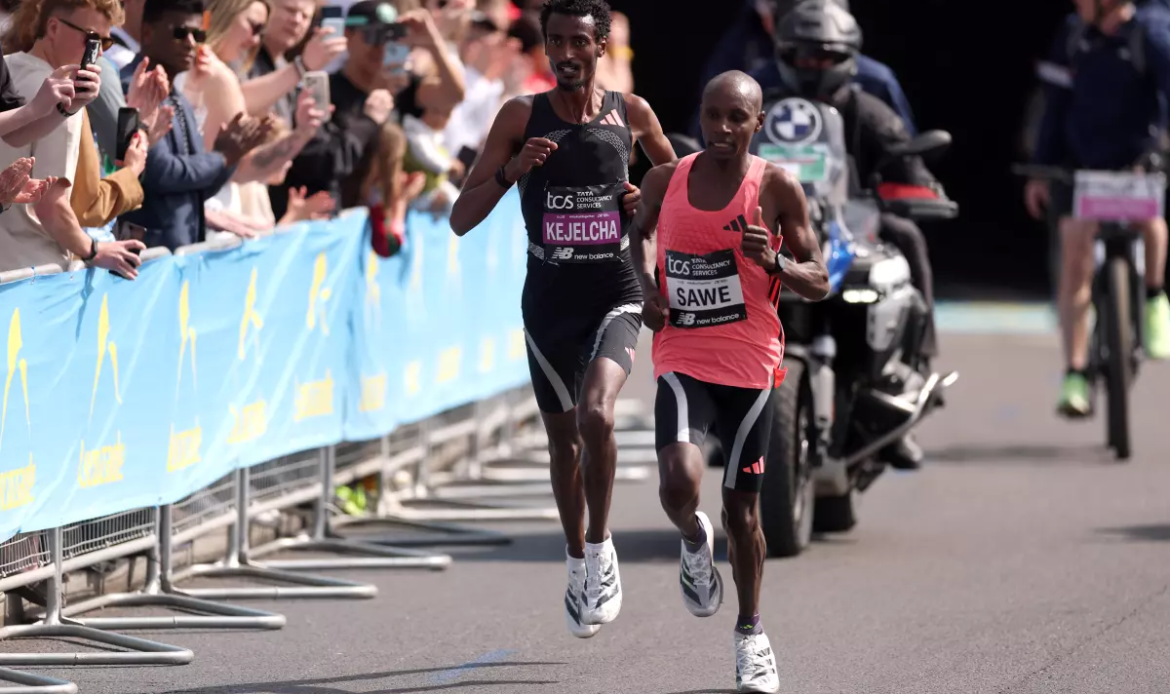
Kenyan long-distance runner Sabastian Sawe has etched his name into sporting history after becoming the first athlete to run a sub-two-hour marathon in an official race, delivering a breathtaking performance at the 2026 London Marathon.
The 31-year-old clocked an astonishing time of 1:59:30, breaking the previous world record and shattering one of athletics’ most iconic barriers. The sub-two-hour mark, long considered unattainable under standard race conditions, had remained a symbolic frontier in endurance running for decades.
Sawe’s performance not only secured victory in London but also redefined the limits of human endurance. His time eclipsed the previous world record by over a minute, underlining the magnitude of his achievement on a course not traditionally associated with record-breaking runs.
In a further twist to an already historic race, Ethiopia’s Yomif Kejelcha also dipped under the two-hour mark, highlighting a new era in marathon running where the once-impossible is quickly becoming reality.
Read: Uar Bernard Makes NFL History with Eagles Draft Selection
From Humble Beginnings to Global Greatness
Sawe’s journey to the top has been anything but straightforward.Born in Kenya’s Rift Valley region, he was raised largely by his grandmother and initially struggled to establish himself in competitive athletics. His early years in professional running were marked by setbacks, including injuries and limited opportunities, forcing him to reconsider his future in the sport.
A turning point came when he connected with renowned coach Claudio Berardelli, who identified his potential and guided his transition into marathon racing. That decision proved pivotal. Despite making his marathon debut only a few years ago, Sawe rapidly rose through the ranks. His performances in Valencia, Berlin, and London had already signalled his potential, but few could have predicted the scale of what he would achieve in 2026.
Even more remarkable is the context surrounding his record-breaking run. Sawe entered the London Marathon after dealing with a stress fracture and back issues that disrupted his training schedule earlier in the year. Yet, on race day, he delivered a performance of extraordinary precision, strength, and mental resilience.
Read: Nigerian Stars Abroad: Big Goals, Big Moments, Big Impact
Science, Strategy and the Future of Marathon Running

Sawe’s historic run also reflects the evolving landscape of elite athletics, where preparation, technology, and strategy are increasingly intertwined.
The Kenyan star reportedly trains at extremely high volumes, covering close to 200 kilometres per week at altitude; a workload that builds both endurance and efficiency. Nutrition also played a critical role, with advanced fuelling strategies allowing him to sustain peak performance deep into the race.
Footwear innovation has further transformed marathon running. Sawe competed in one of the latest “supershoes”, designed to maximise energy return and reduce fatigue. While such advancements have sparked debates around fairness and “technological advantage”, they are now firmly part of the modern competitive framework.
However, Sawe has been equally vocal about the importance of transparency in the sport. Amid ongoing concerns around doping in athletics, he has undergone extensive testing, reinforcing his commitment to clean competition and credibility.
Looking ahead, both Sawe and his coach believe there is still more to come. With his career still in its early marathon stages, the possibility of even faster times, potentially approaching 1:58, is already being discussed.
For now, though, his London performance stands as a defining moment, not just for his career, but for the entire sport.
From record-breaking runs to global sporting milestones, the world of sports never stands still. Stay connected with RefinedNG for deeper insights, breaking stories, and powerful narratives shaping the future of athletics.