In Nigeria, seeking legal help often feels like wandering blindfolded through a bureaucratic maze. The laws are there, buried in old courtrooms and unindexed records, but for most Nigerians, they might as well be locked in another language.
Imagine a young entrepreneur wronged by a business partner or a tenant fighting unlawful eviction. Their first reaction isn’t to consult a lawyer — it’s usually confusion, fear, or resignation. The legal system is viewed as a fortress of privilege, spoken in riddles, and kept out of reach.
For years, the educated, the connected, and the fortunate have enjoyed privileged access to the law. But imagine if the law could speak plainly — on your phone, in your language, and in your context. Picture a machine that helps you navigate the complexities of Nigerian law, driven not by Silicon Valley’s assumptions but by Nigeria’s own court documents.
This is the radical promise of Case Radar — a new AI-powered legal assistant built not to compete with OpenAI, but to do what OpenAI hasn’t even tried: make Nigerian law accessible to everyday Nigerians.
Nigeria’s Legal System and Its Paper Walls
To understand why Case Radar matters, it helps to understand what it’s up against.
For decades, Nigeria has stored its legal knowledge — including thousands of court judgments, case precedents, and interpretations of statutes — in paper-bound archives. These records, some typed with fading ink, scatter across courtrooms and legal libraries, remaining largely undigitized and unavailable to the public. Even trained lawyers often struggle to find relevant case law, particularly in regions with limited technology infrastructure.
Meanwhile, the average Nigerian remains deeply disconnected from the legal system. Whether it’s fear of legal fees, the weight of formal procedures, or a simple lack of information, most citizens don’t consult the law — they avoid it. This disconnect has fostered not just ignorance, but injustice. People sign contracts they don’t understand, endure abuse they can’t name, or miss out on rights they didn’t know they had.
Even today’s smartest AI — ChatGPT, Claude, Gemini — falters when asked about Nigerian legal specifics. Why? Because those documents, the lifeblood of legal interpretation, have never been part of the global internet. They live offline — in boxes, binders, and behind bureaucracy.
That’s the wall Case Radar is breaking.
Read: How Temilade Salami is Making Climate Education a Human Right
Case Radar: A Chatbot with a Law Degree
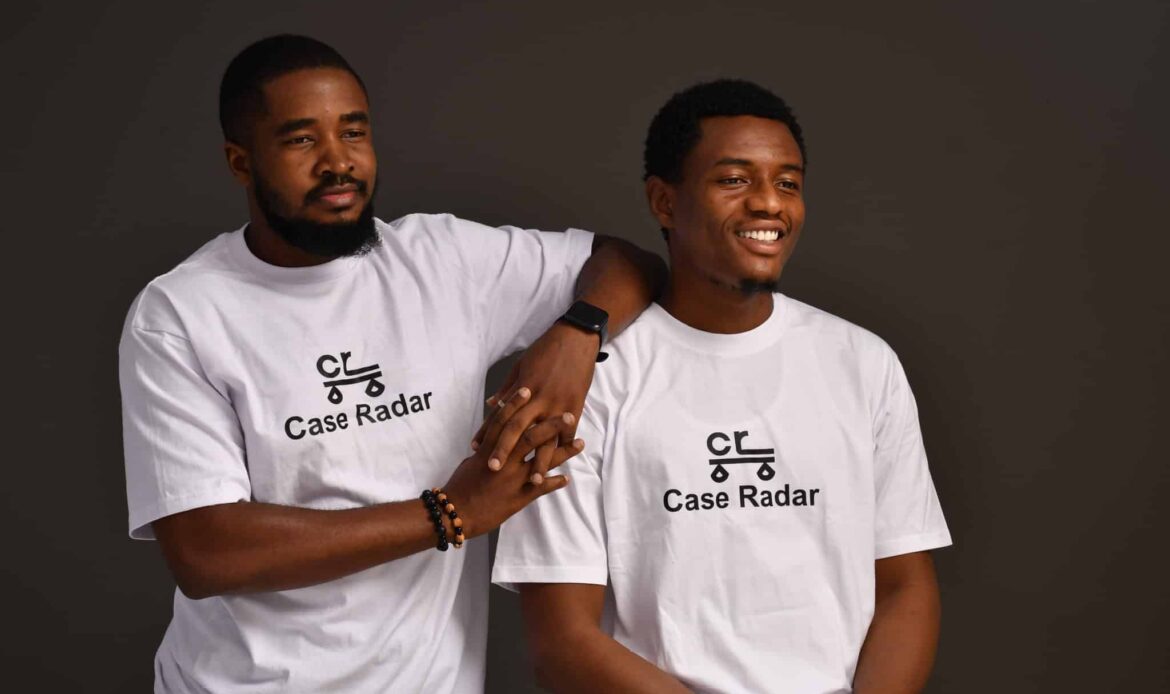
When Agbo Obinnaya and Victory Nnaji launched Case Radar in September 2024, they weren’t just building another AI app — they were taking a sledgehammer to Nigeria’s legal information wall.
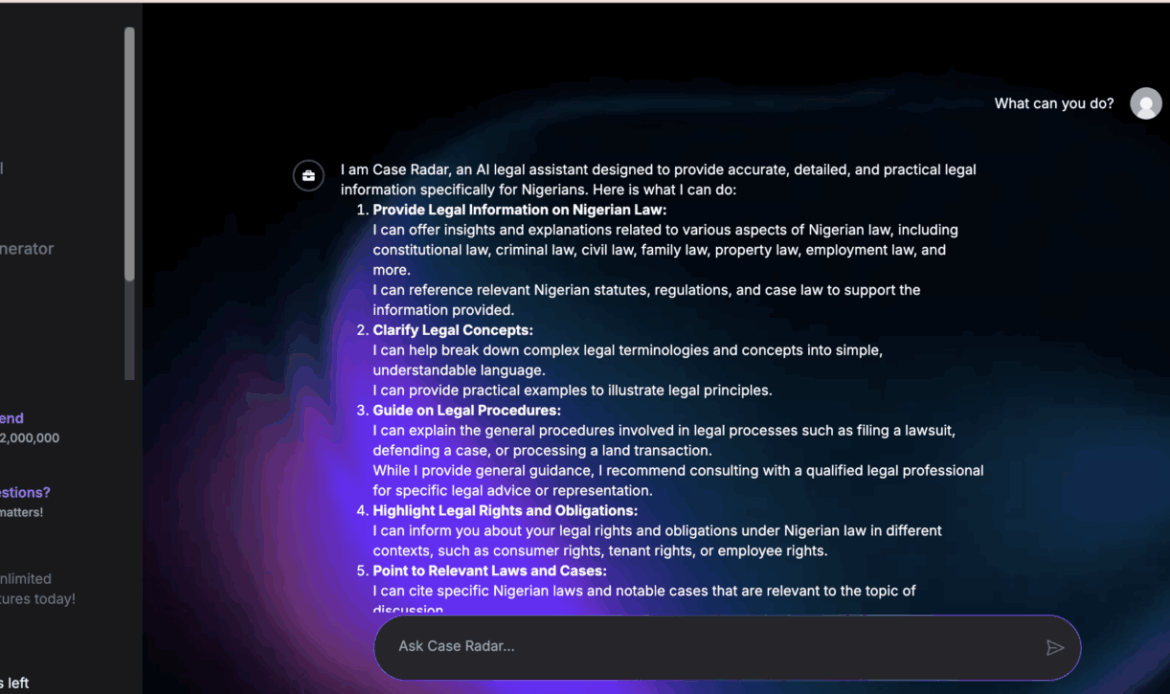
Case Radar is a generative AI platform trained not on general internet data, but on over 10,000 digitised Nigerian court documents — many of which had never been online before. These documents form the core intelligence of the system, making Case Radar uniquely capable of understanding and interpreting Nigerian case law, not just generic legal advice.
The journey to train the model faced numerous challenges. At one point, Victory had to relocate from Enugu to Abuja to process and ship the massive, scattered raw data. Next came the challenge of cleaning and structuring the data. Victory wrote custom code to extract legal insights, remove noise, and format everything for AI training. As a result, they created a chatbot that offered more than just conversational charm; it became a tool that could summarize judgments, analyze legal documents, predict case outcomes, and even connect users with lawyers.
But perhaps its most striking feature is its humility.
“We trained it to just say ‘I don’t know’ when it doesn’t know something,” Obinnaya explained.
This is a direct counter to a growing problem with large language models like ChatGPT — hallucinations. When faced with uncertainty, most AI models will fabricate answers rather than admit ignorance. Case Radar doesn’t pretend. It knows what it knows, and when it doesn’t, it stops.
That alone is revolutionary, especially in law, where a wrong answer can lead to real-world consequences.
USE CASE
Its use cases span a wide spectrum:
- A student studying for bar exams can ask Case Radar to summarise landmark judgments.
- A small business owner can get an overview of tenancy rights or how to draft a simple contract.
- A lawyer can search case law more efficiently and even generate draft documents based on precedents.
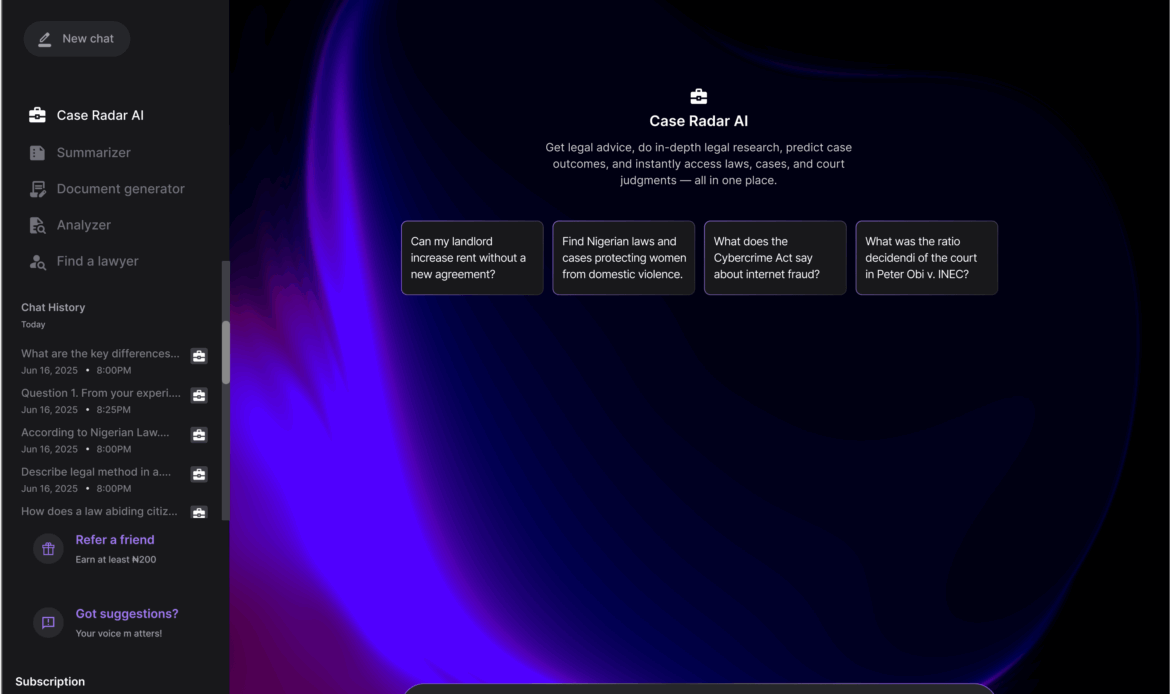
Its interface mimics what Nigerians already know: ChatGPT. Users can chat with it, ask questions, and get responses in plain English. But unlike ChatGPT, Case Radar is local, legal, and trained for the Nigerian terrain.
A New Access Portal: Making Law Public Again
In a country where legal language often sounds like a foreign tongue, Case Radar feels like a translator, educator, and advocate rolled into one.
For decades, the complexity of the Nigerian legal system has intimidated many people. Lawyers serve as gatekeepers, and courtrooms feel like battlefields, making legal information hard to access. Case Radar changes this dynamic by empowering everyday Nigerians with instant access to legal clarity.
According to Obinnaya, one of the driving motivations behind the app was the emotional distance between Nigerians and the law.
“When people talk about the law, they feel fear. I think it’s because they don’t understand it,” he said.
His legal background — combined with years of experience in Web3 marketing — shaped how Case Radar would bridge that gap. Instead of just building software, they built a community around legal literacy. From online campaigns to offline legal education sessions, they pushed a vision: Law shouldn’t be a last resort — it should be your first tool.
The platform now boasts over 1,400 users in under a year, a testament to that vision. And it’s not just the general public that’s using it. Nigerian lawyers, facing unemployment in a saturated job market, can list their services on the platform for a modest annual fee. The app connects them directly with people looking for legal help — a win-win that brings legal services into the digital economy.
Users can access the platform with flexible pricing — from a free trial to hourly, daily, monthly, or yearly plans. With options as low as ₦1,000 per hour, it undercuts traditional legal consultation costs by an order of magnitude.
Through this design, Case Radar isn’t just breaking barriers — it’s creating a whole new legal economy.
Funding, Challenges, and the Fight to Stay Ahead
While Case Radar’s product is compelling and its mission clear, building revolutionary technology in Nigeria is rarely easy — especially without deep pockets. Since its inception, the platform has earned just ₦500,000 (about $330) in revenue, primarily from subscriptions and lawyer listing fees. It’s a modest figure, but one that speaks more to Nigeria’s harsh funding landscape than to the platform’s value.
“We’ve only received funding from family,” Obinnaya admits.
This shoestring approach makes their achievements even more impressive — but also precarious. Competing with global giants like OpenAI, which has billions at its disposal, isn’t just about feature parity. It’s about surviving long enough to evolve. The very infrastructure that powers Case Radar — including its use of GPT — can be replicated. What can’t be cloned as easily is the local insight, structured data, and brand trust they’ve cultivated.
To stay relevant, Case Radar has to keep pushing forward. A mobile app is on the horizon, alongside plans for aggressive marketing and community-building. The goal is not just to acquire users, but to turn legal access into a lifestyle — something people actively engage with, rather than something they fear.
AI is moving fast. Obinnaya and his team know they must move faster.
Read: Meet Damola Adamolekun, The Man Who Saved Red Lobster
The Bigger Picture: Why Case Radar Matters
For most Nigerians, the law has always been something done to them — rarely something done for them. It’s the cop stopping you without cause, the court case that drags on for years, the landlord who ignores your rights, or the employer who violates them. Justice has long been tangled in red tape, jargon, and fear.
Case Radar is cutting through that.
By making legal knowledge accessible — not just to lawyers or judges, but to everyone with a smartphone — Case Radar is doing something quietly radical: it’s democratizing power.
This isn’t just about convenience. It’s about agency. When a trader in Onitsha can ask what her rights are under a new tenancy law, or a student in Zaria can pull up a Supreme Court ruling in seconds, it changes more than just that person’s day. It reshapes civic behavior.
More than that, it challenges the status quo of how justice is perceived and accessed in Nigeria. With every document digitized, every judgment summarised, and every citizen empowered to ask questions, Case Radar moves us closer to a future where law is no longer a mystery, but a mirror — reflecting the people it was meant to protect.
As the platform gears up for its next chapter, one thing is clear: this isn’t just about AI. It’s about reclaiming justice in a country where too many still feel locked out of it.
And if Obinnaya and Nnaji have their way, the law will no longer be something hidden in courtrooms and chambers. It will live where it always should have — in the hands of the people.