
They say what men can do, women can do better, and in the case of Africa’s first female crane operator, that statement is a lived reality. High above the busy port of Lagos, inside a towering machine that weighs hundreds of tonnes, Taiwo Omotayo Oni took control and made history. No noise, no drama, just skill, precision, and a clear message: the rules were changing.
Breaking Ground in a Male-Dominated Space
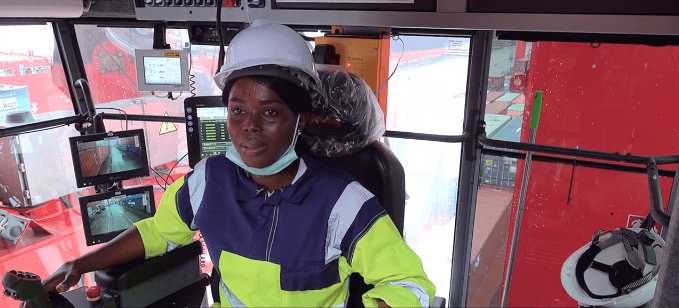
In November 2017, Taiwo Omotayo Oni stepped into the spotlight as Africa’s first female mobile harbour crane operator. She wasn’t alone; she was part of a five-woman team trained at the Tin-Can Island Container Terminal (TICT) in Lagos, Nigeria. Alongside Tina Onwudiwe, Adewale Adegoroye, Adeniran Matilda, and Ajayi Oluwaseun, she helped shift an entire industry’s perception of who belongs behind the controls of heavy machinery.
Crane operation, especially in ports, has long been viewed as physically demanding and technically intense work; fields traditionally reserved for men. But this group didn’t just participate; they excelled. They trained on Rubber Tyre Gantry (RTG) cranes and mobile harbour cranes, machines responsible for lifting, stacking, and transporting massive shipping containers with pinpoint accuracy.
It was a full-scale, hands-on entry into one of the most critical roles in maritime logistics.
Read: Grace Ladoja Makes History as First African Woman to Design Nike Sneaker
The Investment Behind the Breakthrough
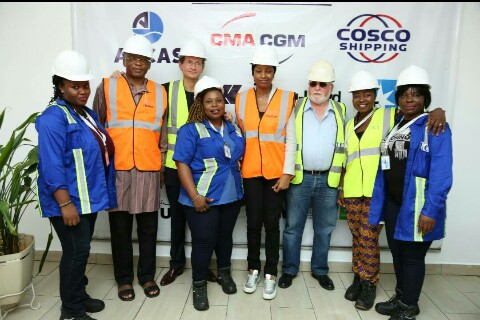
Change like this doesn’t happen by accident; it requires commitment. TICT invested €15,000 in training each of the five women, totalling €75,000. The training itself was rigorous, including six weeks of intensive instruction led by international experts, followed by certification and continued on-the-job development. It paid off in the end.
Operating a harbour crane isn’t just about pulling levers. It involves spatial awareness, coordination, real-time communication systems, and the ability to manage high-pressure tasks with zero margin for error. From a cabin roughly 30 metres above ground, Oni and her colleagues manoeuvre containers weighing several tonnes with calm precision. It’s technical. It’s demanding. And they mastered it.
More Than a Personal Win
Oni’s achievement wasn’t just a personal milestone; it became a signal across Nigeria and the wider African continent. Her success challenged outdated assumptions and opened doors for other women to consider careers in industries they may never have imagined.
She herself put it simply: once you set your mind to something, you can do it. That mindset has since echoed across the sector, encouraging more inclusive hiring and training practices.
And the ripple effect is already visible.
In Nigeria’s eastern ports, Fubara-Precious Ibiso Wiseman later became the first female RTG operator at the West Africa Container Terminal in 2021. In South Africa, women like Zoliswa Gila have stepped into crane operation roles within construction. Even beyond West Africa, countries like Morocco are seeing women take on port crane operations, signalling a steady continental shift. What started as a single initiative is now part of a broader movement.
Read: Olugbemisola Odusote Becomes First Female DG of Nigerian Law School
Changing the Narrative of Work and Capability
There’s something powerful about visibility. Seeing a woman operate a giant crane, confidently, competently, without hesitation, reshapes expectations in a way policies alone cannot.
Oni and her colleagues didn’t just learn a skill; they redefined what capability looks like. They proved that technical industries don’t have a gender limit, only a skills requirement. And when given equal access to training and opportunity, women meet that standard without compromise.
This moment also highlights a larger truth about workforce development in Africa: investing in people, regardless of gender, drives progress. When industries tap into a broader talent pool, they improve performance, innovation, and resilience.
Why This Story Still Matters
It’s easy to see this as a one-off “first”, but its significance runs deeper. Every industry has its invisible barriers, assumptions about who fits where. Stories like Oni’s challenge those assumptions head-on.
And here’s the key part: representation isn’t just about inspiration. It’s about access. Once a barrier breaks, it becomes easier for others to step through. That’s how change compounds.
If you’re into stories that spotlight overlooked pioneers, industry disruptors, and revolutions shaping Africa’s future, don’t miss out. Join our mailing list and stay plugged into the people and moments rewriting the narrative, one bold move at a time.