

In 2017, Naom Monari was a young student nurse working inside Kenya’s public health system, and what she saw broke something open in her. “I saw families drained financially and emotionally by long-term hospital stays for their loved ones,” she has written. “
The pain was not just in the illness but in the struggle for dignity and care.” That observation didn’t stay an observation. It became Bena Care, and years later, it became a converted shipping container driving down a Kenyan highway, carrying four dialysis machines to people who had never been able to reach one.
A Company Built From What She Refused to Accept
Bena Care started small and practical: a network of nurses, physiotherapists, and caregivers delivering affordable home-based nursing and therapy, so families wouldn’t have to choose between a loved one’s care and their own financial survival.
Related: Sylvestre Nsengimana: From Personal Healing to Performance

It has since served more than 16,000 patients, cutting healthcare costs for many by as much as half. But Monari describes the numbers as the least of it. “Behind these numbers are stories, a mother relieved that her son can receive dialysis closer to home, a daughter able to provide care for her mother because she was trained by our team. These are the stories that keep me going, even when the road ahead looks incredibly difficult to navigate.”
When the Data Confirmed What She Suspected
After 2019, Monari’s team noticed a troubling rise in patients needing dialysis. Rather than guess at why, she secured a research grant from Canada’s International Development Research Centre and partnered with a local university on a year-long study, conducted between 2022 and 2023, in a county heavily burdened by kidney disease.
What they found was stark: patients were routinely travelling up to 200 kilometres, twice a week, just to reach treatment. Missed sessions were common, and for dialysis patients, a missed session can be fatal. Monari’s conclusion was blunt: distance should not decide who lives.
Turning a Shipping Container Into a Clinic
The answer was Renal Roads, a used 40-foot shipping container that Monari, working with biomedical engineers, medical statisticians, university researchers, and local Jua Kali fabricators (Kenya’s informal-sector metalworkers and technicians), converted into a fully functioning mobile dialysis unit.
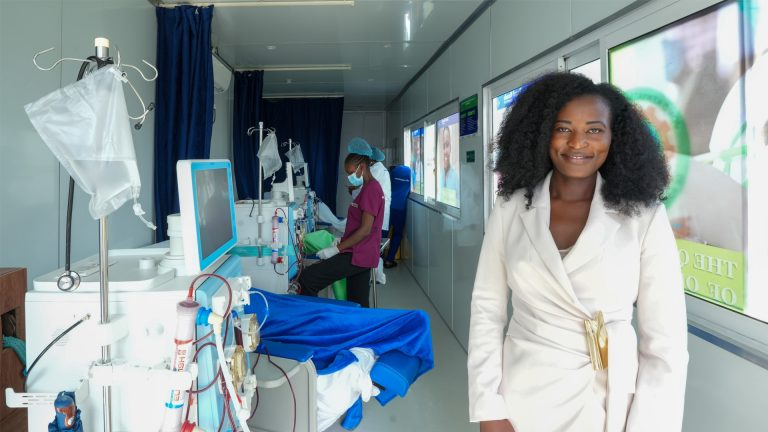
It holds four dialysis machines, reclining treatment chairs, an emergency area built to clinical infection-control standards, a reverse osmosis water treatment system for the large volumes of purified water dialysis requires, and solar power with backup systems so it can run off-grid. The entire mobile configuration is protected under a utility patent, because keeping a hospital-grade system safe during transport was the genuine engineering problem to solve.
The truck now rotates through three communities a week, running two four-hour sessions per patient and up to twelve sessions a day, with a county nephrologist providing clinical oversight and trained renal nurses delivering care on-site.
Related: How Nyifamu Ogechi Manzo Is Supporting Nigerian Farmers
After launching in Murang’a County, the results were measured, not just felt: a 76.6% reduction in patient travel distance, and a jump to 100% treatment adherence. One patient, a 26-year-old mother of two who had been travelling 70 kilometres each way for treatment, described the unit’s arrival near her home as an answered prayer. Sessions are reimbursed through national health insurance, meaning the model isn’t just compassionate, it’s built to last.
With one unit running and a second ready for deployment, Monari’s ambition is regional. “Our goal is simple: bring life-saving care closer to people who need it,” she says. “The first version has worked, but three years from now it will be more compact and efficient.”
Stay With Us For More
At RefinedNG, we spotlight Africans who are quietly and boldly reshaping their industries — the innovators, builders, and change-makers whose work deserves to be known. Follow RefinedNG for more stories on the people building what comes next.