
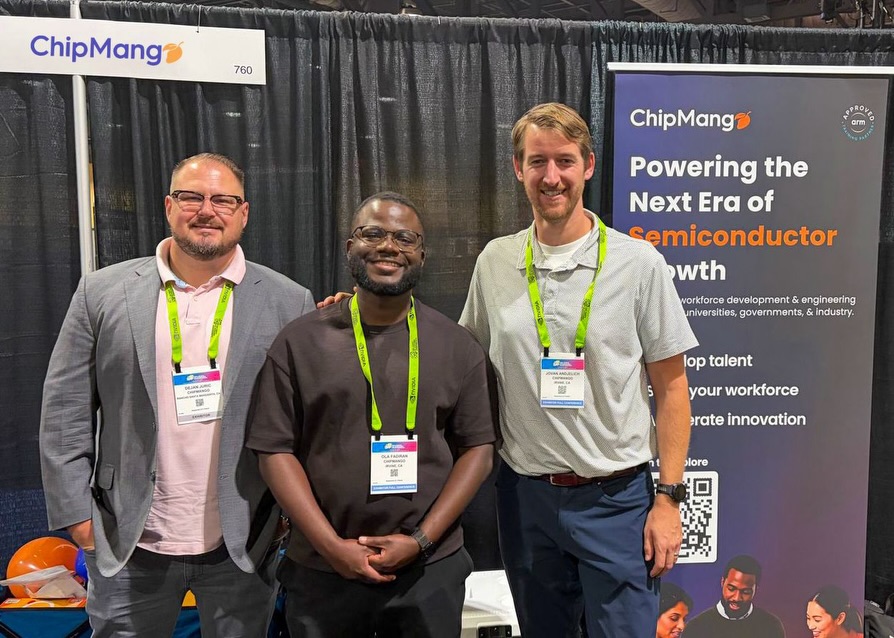
ChipMango, the California-headquartered semiconductor technology company founded by Nigerian engineers, has raised $1.9 million in seed funding to expand its chip-design operations and develop more semiconductor talent across Africa.
Atlantica Ventures led the round, with participation from DFS Labs, Kaleo Ventures, Madica, Trilinear Technologies, Malta Ventures and other investors. The company plans to use the funding to expand its engineering and product-development capacity, grow its workforce platform and deepen its work in edge AI and intelligent sensors.
The funding comes as demand for semiconductor expertise continues to grow globally, giving African engineers an opportunity to participate in a technology industry that powers everything from smartphones and vehicles to artificial intelligence systems.
Read: Fope Adelowo Is Helping Decide Which African Tech Ideas Get to Scale
ChipMango Raises Funding to Expand Engineering Capacity
Founded in 2022 by Ola Fadiran and Jovan Andjelich, ChipMango operates across two areas of the semiconductor value chain: training engineers in chip design and deploying those engineers on commercial semiconductor projects.
The company does not manufacture chips. Instead, its engineers work on the design and verification stages before manufacturers produce the final hardware.
With the new funding, ChipMango will expand its engineering teams, take on more commercial design engagements and scale its AI-native learning and workforce platform. It also plans to strengthen operations across Africa, the United States and Europe.
For Fadiran, the company’s co-founder and chief executive, the opportunity extends beyond traditional software development.
‘The next era of AI will not be defined by software alone,’ Fadiran said. ‘It will depend on who can design the chips, systems and intelligent hardware that power it.’
That approach places specialised engineering skills at the centre of ChipMango’s growth strategy.
Building a Semiconductor Talent Pipeline in Africa
ChipMango’s workforce platform gives learners browser-based access to semiconductor design environments, electronic design automation tools and intelligent learning support. The company has built the programme around commercial engineering workflows, helping learners move from academic knowledge towards industry-ready skills.
Its partnerships also form an important part of that pipeline. ChipMango has joined Arm’s Approved Training Partner programme and works with technology companies and academic institutions, including Synopsys, Ohlone College in California and the University of Pretoria in South Africa.
The company also works with Nigerian universities, including Miva Open University, Obafemi Awolowo University and the University of Lagos, to reach students with engineering backgrounds and build their specialised semiconductor skills.
This training model connects education directly to practical work. Engineers can develop their expertise while gaining exposure to commercial projects, creating a talent pool that serves both African and international technology companies.
Read: Bello Opeyemi on Why CashAfrica Is Building Payments Around People
Taking African Chip-Design Talent Global
ChipMango is also building a commercial business around the talent it develops. Its engineers provide chip-design and verification services to companies that require additional technical capacity, including work with Trilinear Technologies on verification projects for consumer, automotive and industrial applications.
The company plans to establish a European design centre in Malta with Malta Ventures. It also intends to support initiatives in Kigali, Rwanda, focused on semiconductor capability, workforce development and AI infrastructure.
The expansion comes against a wider global talent challenge. Deloitte estimates that the semiconductor industry could require more than one million additional skilled workers by 2030, while Africa has millions of young people entering the labour market every year.
For ChipMango, that creates an opportunity to connect Africa’s engineering talent with a global industry that needs specialised skills.
‘The semiconductor industry’s binding constraint is no longer capital; it is people,’ said Anikó Szigetvári, founding partner at Atlantica Ventures.
ChipMango’s latest funding gives the company more room to develop that talent, expand its commercial work and strengthen Africa’s presence in semiconductor design. As AI and intelligent hardware become increasingly important, the engineers designing the technology will matter just as much as the software running on it.
Follow RefinedNG for more stories on African innovators, businesses and technologies shaping what comes next.