For millions of students across Nigeria, gaining admission into a university can feel less like a structured process and more like a gamble. Every year, talented students with strong grades find themselves shut out of higher education, not because they lack ability, but because navigating the system is confusing, fragmented, and often driven by incomplete information. This is the problem KollegeScout was built to solve: helping students make informed decisions about higher education while also connecting universities with qualified candidates.
The idea for KollegeScout was born from founder Fiyinfoluwa’s own experience. While applying to universities in 2019, he realized firsthand how opaque the admission process could be. Watching a close friend struggle to secure a spot, despite excellent grades, revealed that access to accurate information could mean the difference between opportunity and setback.
In this conversation with RefinedNG, Fiyinfoluwa reflects on the personal experiences that inspired KollegeScout, the challenges of building a startup from scratch, the milestones that validated the vision, and the long-term mission to reshape access to higher education across Africa.
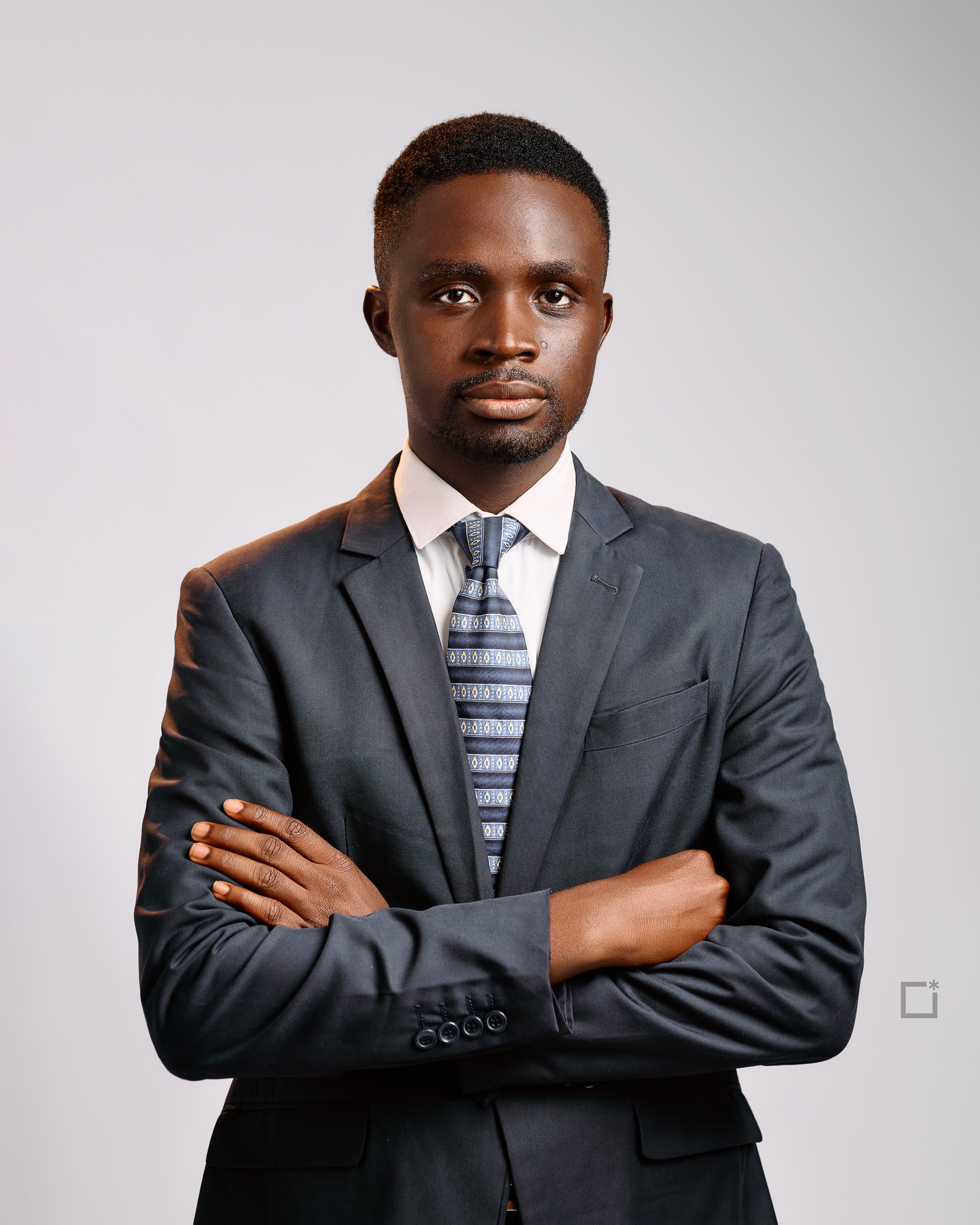
“Before we even get into KollegeScout as a company, I want to start with you. Every strong solution is usually born from lived experience. So we’re curious, what experience shaped how you came about KollegeScout? Let’s know the backstory
Fiyinfoluwa: In 2019, I was applying to university after my final year of secondary school. Like many Nigerian students, I applied to UNILAG because it was a trending school. I wanted to be in Lagos, and I made OAU my second choice. Bad idea.
I had good grades; however, they were not enough for UNILAG. The second choice option for federal universities is basically pointless because they won’t consider you. I was rejected by UNILAG.
That process was very emotional, and trying to figure out what other options were available to me and finding the data to make an informed decision wasn’t easy. At the time, there wasn’t a single platform where you could access that information.
But I was lucky. My parents were able to put me in a private university, so my situation wasn’t as severe. However, I had a friend who was applying to university for the second time that same year. She didn’t get in that year, and a couple of months later she was still applying. She didn’t get in until her fifth attempt, despite scoring over 300 every time. Eventually, she got into Medicine at the University of Ibadan after applying to several schools.
Seeing a close friend struggle through that process was the motivation behind building KollegeScout.
I learned programming quite early, just before finishing secondary school. I started with Python, moved into Machine Learning, and eventually learned Full Stack Development. Also, I was already doing tech internships before I graduated.
After school, I worked in several tech roles in payments, digital platforms, and gaming. With those skills, I realised I could build a solution to solve this problem.
That’s why I built KollegeScout.
It’s interesting how personal experiences often become the seed for innovation.
Fiyinfoluwa: As a side note, also, it wasn’t enough to just be intelligent, to get into a university. My friend had good grades but she didn’t get in. I also had good grades, and in fact, I eventually finished with a first class in Electrical Engineering. I knew that good grades weren’t enough in the very confusing and competitive Nigerian system.
Read: How Kollegescout Helps Students Find the Right University in Nigeria
At what point did you realise that the problem you noticed wasn’t just something you went through personally, but something that required a scalable solution? When did it shift from ‘this is frustrating’ to ‘this needs to exist’?
Fiyinfoluwa: I knew this was a problem that shouldn’t exist while I was still in school, probably around my third year. At the time, I didn’t know that I would immediately go on to build the solution.
But while learning software development and working in tech companies, I began to see how technology was impacting people’s lives. A couple of months after I graduated, I started thinking that with my skills, I might actually be able to solve this problem.
So I decided to build.I remember having an epiphany at one point. I had an exam and I was already prepared for it, but the idea just came to mind and I said,okay, let’s do this.
I called my sister and asked, “Is this a real problem? Can we build something to solve it?”And that was how KollegeScout was born.
That’s really nice. Moments of clarity can help to shape one’s idea also. So moving on to KollegeScout. How did you come up with the name KollegeScout? Why that name?
Fiyinfoluwa: When we first had the idea, we tried all sorts of variations for a name: ForseeCollege, Apply College, Unipass, Unigate, but most domains were already taken. Then it hit us: what are students actually doing when they look for a university? They’re scouting. So, students are literally scouting for universities.
What I didn’t emphasise earlier was that this problem wasn’t just for students. I went to a private university and saw firsthand how many private institutions struggle to recruit students. Ask students in most private universities, especially the less popular ones, and about 70% would say that the school they were in wasn’t their first choice; more often than not, their first choice was a government institution.
On the flip side, private universities were spending huge budgets on ads, TV spots, billboards, and online platforms just to attract students, but the process was inefficient. That’s where KollegeScout comes in. We help students find universities while also helping universities recruit students.
So the name ‘KollegeScout’ reflects both sides: students scouting for universities, and universities scouting for students. We’re basically the bridge connecting the two. And yes, we used a ‘K’ because that’s what made the domain available.
Wow, that’s really a lot of work, you know, having to come up with a name for a startup. Moving on. Early-stage building can be messy. What were some of the biggest obstacles you faced when getting KollegeScout off the ground? Was it funding, credibility, technical challenges, partnerships, or something else entirely?
Fiyinfoluwa: I’d say the major challenge early on was figuring out exactly what the platform should be. When you’re tackling a problem in a broken market, you first have to define the solution. That meant running multiple iterations, conducting interviews with university administrators, staff, and students, and really digging into the pain points before we could design the right solution.
That process wasn’t quick. It took time and repeated refinements, but slowly it became clearer. Mark Zuckerberg once said ideas don’t come fully formed, they only take shape as you work on them. That was exactly our experience.
Before KollegeScout existed digitally, we had a community manually assisting students with university applications, and we saw over a 60% success rate. Translating that manual process into a structured, digital platform, figuring out the most effective student-university matching system and identifying the key data points needed, was a huge challenge.
Of course, the usual startup hurdles applied too. Funding, for instance. We’ve bootstrapped the entire project so far, relying on personal savings and support from family. No external investment yet, but that’s part of the journey.
Given that this is a bootstrapped startup, at any point in time, did you feel like the progress was slow or that this wasn’t going to work out in time? How did you cope with maybe the pressure or the slow progress?
Fiyinfoluwa: At certain points, I did feel progress was slow. We were working with people to build the platform. A lot of people volunteered time to do this. And did I feel it was slow? Yeah, slow. But I never give up. I have learned doggedness from a number of childhood experiences. While we encountered challenges, I have not had any doubt that we are on the right track and we would succeed. I focus on the destination, though, we’ve changed our strategy several times to adapt to market realities, but we’ve not lost faith or had doubt that this would work.
Why we are still moving is because we are building something that doesn’t particularly exist in the market at the moment; how we are building it doesn’t exist in Nigeria. It can be challenging, but I know that the rewards of succeeding would have an impact in many lives.
It’s always powerful to hear what sustains a founder beyond the headlines. Let’s shift perspective for a moment and talk about what you’ve built. Looking at KollegeScout today, what would you describe as the defining milestones so far? The moments where you paused and thought, ‘This is becoming something significant.
Fiyinfoluwa: One of the most defining milestones for us was being accepted into the NASDAQ Entrepreneurial Center Milestone Makers Program. This is a global accelerator for entrepreneurs building solutions aligned with the UN’s Sustainable Digital Goals. In October 2025, we joined the EdTech cohort alongside innovative companies from the US, Peru, and across Africa.
In the same cohort were two Forbes 30 Under 30 entrepreneurs, ALX, and several other standout EdTech companies. KollegeScout being one of only eleven companies selected was immediate validation that we were onto something significant.
The NASDAQ program helped us refine our business model, strengthen our pitch, and improve our customer acquisition strategy, bringing structure and focus to the company and positioning us for long-term growth.
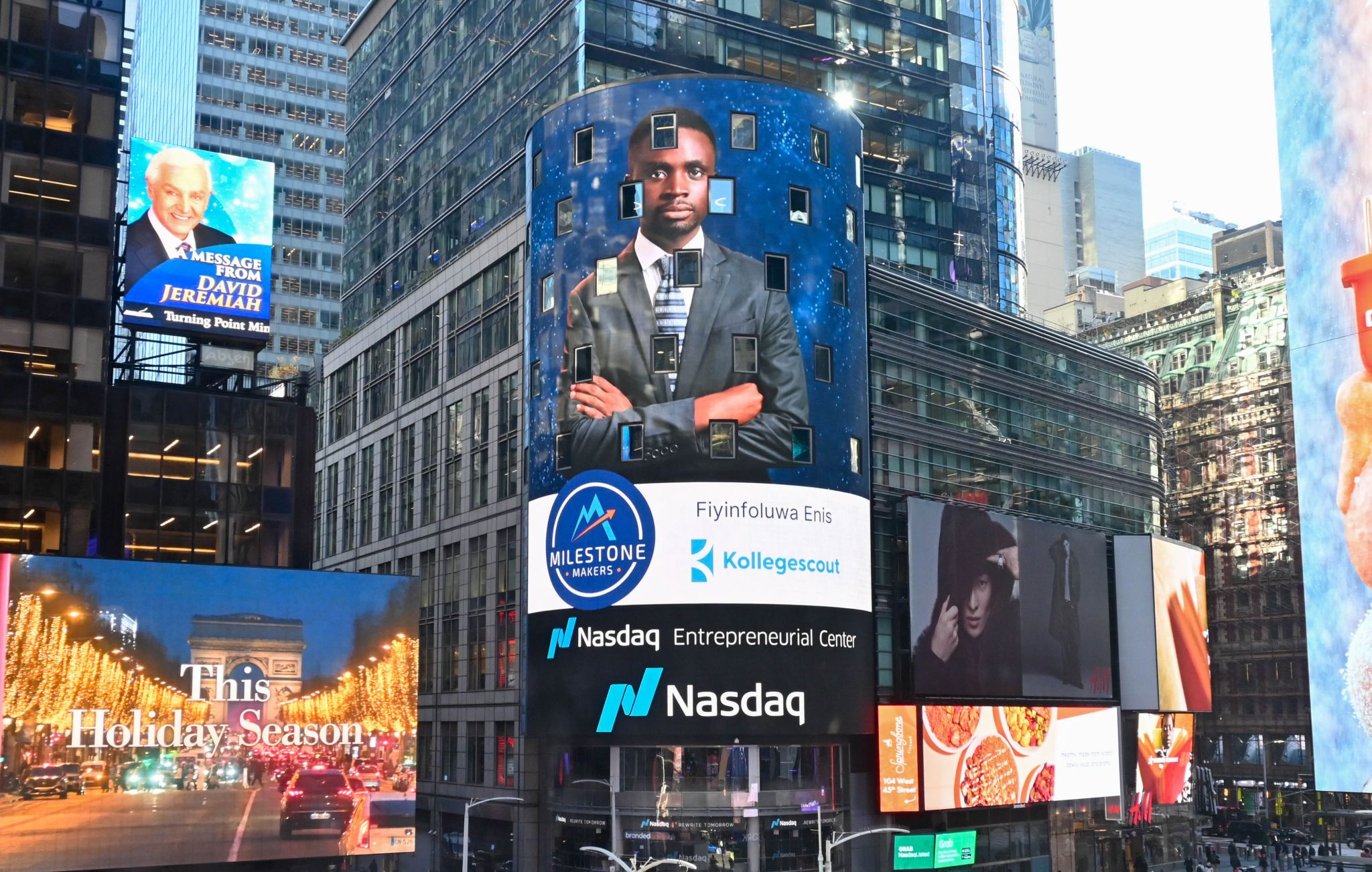
After the program, we were featured on the Times Square NASDAQ MarketSite Tower in New York, one of the most iconic billboards in the world. It’s typically where companies go public to showcase themselves, so seeing KollegeScout on that platform alongside global companies was an incredible validation. It showed us early on that what we are building is impactful, sustainable, and recognised internationally.
What change are you expecting that KollegeScout can make within the educational system in Africa? Given what you guys are doing currently, what things are you looking to implement?
Fiyinfoluwa: By 2050, Africa will have the largest youth population in the world, about a third of the global working population will be African. But today, the continent’s gross enrollment ratio in higher education is only around 10%. That means for every one student in higher education, nine are left out, far below the global average of 23%.
We don’t talk enough about what will happen to a continent where the working population does not have higher education. We can either be a blessing that unlocks a huge opportunity when our population grows, or we can be a liability to the world and have our crime and vices rate increase because the people are not productively employed and engaged.
KollegeScout is building the infrastructure to prevent that looming crisis. We aim to increase enrollment in higher education, ensuring Africa’s workforce is educated, skilled, and ready to contribute to the global economy.
So basically, Mission 2050 is to improve gross enrollment ratio in Africa. That’s one to look forward to.
Fiyinfoluwa: We don’t talk enough about what happens when students don’t get into higher education in Nigeria and across Africa. Many end up in lower socio-economic classes, taking informal jobs and learning trades on a local scale. Without formal education, it’s much harder to scale those skills or access opportunities, and higher education remains the single most important factor determining whether someone escapes poverty or stays trapped in it.
A more educated society has a direct, long-term impact on individuals’ ability to earn and contribute economically. That’s why what we’re building with KollegeScout is so important. It’s not just an EdTech solution, it’s about the workforce, shaping minds, and ensuring people are equipped to participate meaningfully in the economy. Higher education improves critical thinking, equips people with skills, and creates pathways for productive engagement.
Over the past six years, around six million students have failed to secure admissions. Many continue to try, but after three to five years, they often give up. Those millions then enter the informal economy, unable to reach their full potential, and the cycle of poverty persists. KollegeScout is working to break that cycle, scale up opportunities across Africa, and develop human capital that can contribute effectively to the economy while earning a decent living
A big thumbs up to you guys. Let’s talk about you being a founder, an entrepreneur. Every founder will tell you that the process has taught them one thing or another. It’s not always an easy journey. So what is that one thing that KollegeScout has taught you?
Fiyinfoluwa: The most important lesson I’ve learned is that business is about people. Solutions are about people, whether it’s the customer, the service you provide, or the impact you create in society, it all comes down to people.
As a founder, I’ve learned to appreciate, develop, and trust my team, and to give them their flowers. I have an incredible team at KollegeScout, and the progress we’ve made is because of them. They are the ones achieving milestones and bringing this vision to life.
Everything I do is also deeply grounded in faith. As a Christian, I believe this idea was inspired by God, and that shapes the way I lead and build. My goal is to honour Him while creating solutions that benefit humanity. My personal philosophy is simple: I exist to glorify God and to bring good, joy, and impact to the lives of others.
Every founder has had to make one tough decision, whether people understand it or not. So have you had to make any decision that most people don’t see or they don’t understand?
Fiyinfoluwa:The biggest decision I’ve made is to start solving this problem in Nigeria, right here at home. I have a strong network globally, and people often ask, ‘Why not work at Google, Amazon, or Apple? Why not focus on international education from the start?’ They see the market here as small and question whether people can pay for a solution like this.
Currently, KollegeScout’s core features are free for students, though premium features for universities are planned. Nigeria has about 309 universities and over 900 higher education institutions in total. By global standards, that might seem small, so some wonder why we’re not targeting international education, which could be more lucrative.
I could have focused on international markets and been wealthier faster, but this isn’t just about money. I want to solve a painful problem I’ve experienced firsthand. Also, I want to ensure students don’t go through obstacles that shouldn’t exist. While the world chases AI or immediate exponential returns, we are building solutions for society and solving problems that millions of people actually experience. And we strongly believe that creating real impact leads to real, sustainable returns.
Take Nathan Nwachukwu, for example. His company, Terra Heptics, started by solving critical infrastructure challenges in Nigeria and recently raised $34 million. By solving a real, pressing problem first, he unlocked opportunities people didn’t even see at the start. That’s the approach we’re taking: prioritising impact, building for the long term, and trusting that both lives and financial returns will follow.
Read: African Defence Tech Startup, Terrahaptix, Reaches $100m Valuation
When you look back in the next 10, 15, 20 years, what are you hoping would have changed, particularly in this sector?
Fiyinfoluwa:Before major FinTechs emerged in Nigeria, many innovations, like banking the unbanked or giving merchants access to financial services, seemed impossible. But someone saw the opportunity and built solutions that the world hadn’t created for us. That’s the lesson: Africans need to build solutions for Africans. No one is coming to save us; we have to shape our own future
.In the next 5 to 10 years, I envision a future where admissions in Nigeria are no longer a lottery. Students will come to KollegeScout, see all their options, know exactly which schools they qualify for, and have a guaranteed chance at admission once they meet the criteria. Universities will proactively reach out to students through our platform, making the process informed, transparent, and fair.
I also envision Africa’s gross enrollment ratio rising from 10% to 25% within the next decade. KollegeScout will play a key role in changing this trajectory, doubling the number of students enrolled in higher education, maximising opportunities for students, universities, and even online institutions or alternative educational pathways. The long-term goal is a well-educated, skilled, and empowered workforce that can drive Africa’s growth and development.
On a final note, for someone out there, maybe a student, that will read this, what’s that advice you have for them regarding their educational journey?
Fiyinfoluwa: My advice is that the options available to you for a career that maximises your potential are far broader than what you’ve been exposed to. Many students only see a few familiar paths: lawyer, doctor, engineer, content creator, but the reality is that there are countless opportunities out there. And your course of study doesn’t necessarily limit the careers you can pursue.
Higher education equips you with critical thinking and problem-solving skills that you can apply to any field. For example, I studied Electrical Engineering, which had very little focus on software development, but the math and problem-solving foundation I gained allowed me to pick up machine learning and other tech skills on my own.
The key for students is to be open-minded. Don’t feel confined to a single school or programme. Explore options, be curious, and build skills that will allow you to tackle any problem or opportunity you encounter.
That’s exactly what KollegeScout is designed to support, giving students the knowledge and tools to make informed decisions and maximise their potential.
KollegeScout is more than a platform—it’s a movement reshaping access to higher education in Nigeria and beyond. Follow RefinedNG to stay inspired by stories of innovation, impact, and the people building Africa’s future.